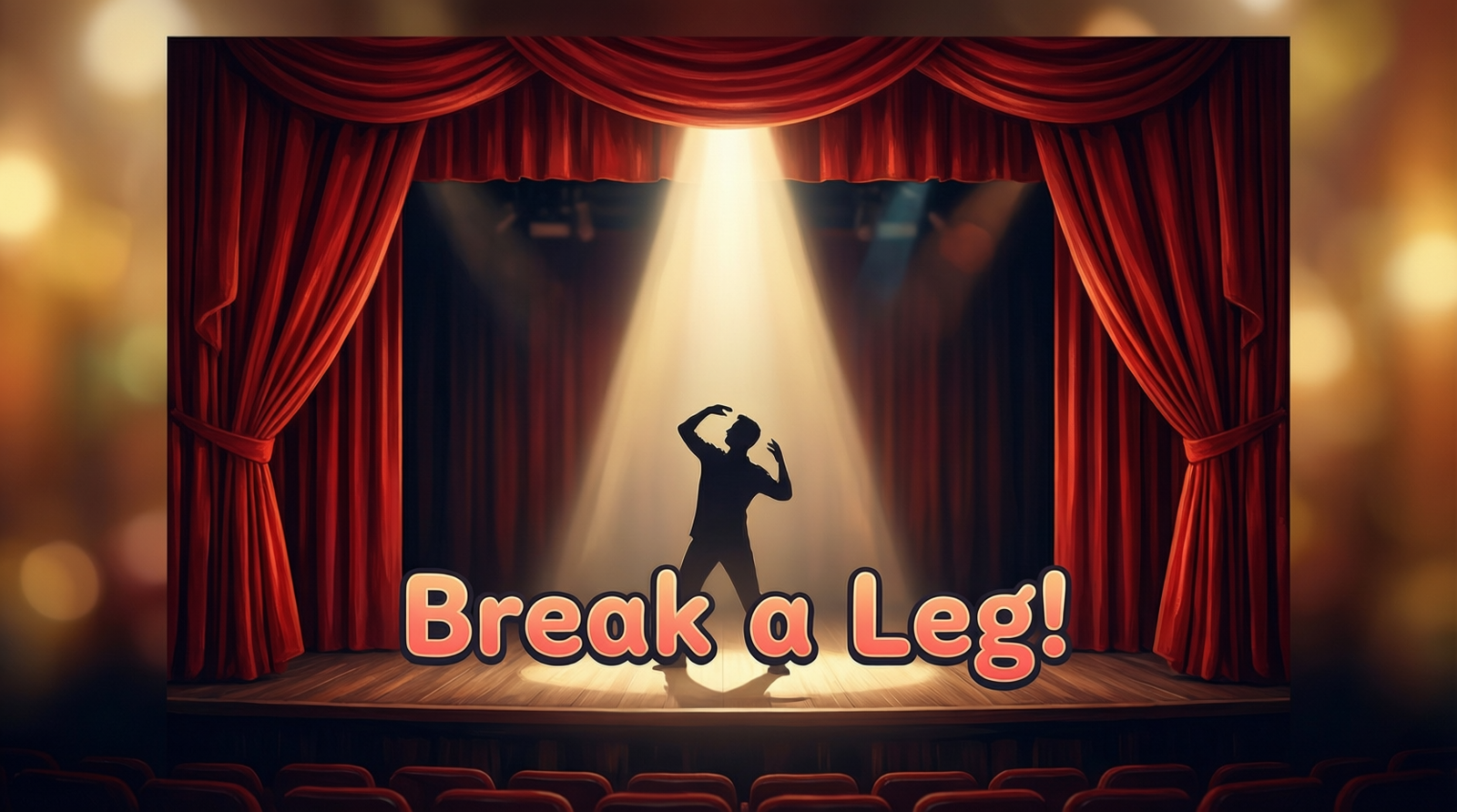
The Break a Leg Metaphor is a famous expression used to wish someone good luck, especially before a performance or big moment. Imagine two actors standing backstage before the curtain rises.
One whispers nervously, “I hope everything goes well tonight.”
The other smiles and says, “Relax… break a leg out there.”
Even though it sounds strange, the phrase isn’t meant literally. In theater and performing arts, saying “break a leg” is a playful and superstitious way of wishing someone success without actually saying “good luck.” In this guide, we’ll explore the meaning of the break a leg metaphor, where it came from, and how it’s used in everyday language and performance culture.
Let me ask you something real quick.
Have you ever heard someone say Break a leg! right before a performance, and thought, Why on earth would anyone say that?
You’re not alone.
On the surface, it sounds harsh, almost cruel. But of course, no one actually wants you to get hurt. That’s where metaphor steps in. Language does this funny thing where it says one thing but means something completely different, and break a leg is one of the most famous examples.
So yes, Break a leg is a metaphor. It’s a phrase that uses imagery to express encouragement and good luck without stating it directly. And once you understand how metaphors work, you’ll start noticing them everywhere.
20 Metaphors Explained (With Meaning, Explanation, and Examples)
1. Break a leg
- Meaning: Good luck
- Explanation: Especially used in theater, it avoids directly saying good luck, which was once considered bad luck.
- Examples:
- You’ve rehearsed for months, break a leg tonight!
- She whispered break a leg before he stepped on stage.
- You’ve rehearsed for months, break a leg tonight!
2. Time is a thief
- Meaning: Time passes quickly and takes moments from us
- Explanation: Time is compared to a thief because it steals without us noticing.
- Examples:
- Time is a thief when you’re having fun.
- Looking back, he realized time had stolen his youth.
- Time is a thief when you’re having fun.
3. The classroom was a zoo
- Meaning: The place was noisy and chaotic
- Explanation: A zoo symbolizes loudness and disorder.
- Examples:
- After lunch, the classroom was a zoo.
- It turned into a zoo once the teacher left.
- After lunch, the classroom was a zoo.
4. Her words were a dagger
- Meaning: Her words were deeply hurtful
- Explanation: A dagger suggests emotional pain instead of physical harm.
- Examples:
- Her words were a dagger to his confidence.
- That comment felt like a dagger in my chest.
- Her words were a dagger to his confidence.
5. He has a heart of stone
- Meaning: He is emotionally cold
- Explanation: Stone represents hardness and lack of feeling.
- Examples:
- He seemed to have a heart of stone.
- Only later did she realize he wasn’t heartless at all.
- He seemed to have a heart of stone.
6. The idea sparked interest
- Meaning: The idea caused excitement or curiosity
- Explanation: A spark suggests the beginning of something.
- Examples:
- Her proposal sparked interest across the team.
- That book sparked my love for history.
- Her proposal sparked interest across the team.
7. She’s drowning in work
- Meaning: She has too much work
- Explanation: Drowning implies being overwhelmed.
- Examples:
- She’s drowning in deadlines.
- I can’t help today, I’m drowning in work.
- She’s drowning in deadlines.
8. The world is a stage
- Meaning: Life is like a performance
- Explanation: People play roles just like actors.
- Examples:
- He believed the world is a stage.
- In politics, the world truly feels like a stage.
- He believed the world is a stage.
9. That news hit me like a truck
- Meaning: The news was shocking
- Explanation: A truck suggests sudden, heavy impact.
- Examples:
- The diagnosis hit me like a truck.
- That plot twist hit hard.
- The diagnosis hit me like a truck.
10. She’s a walking encyclopedia
- Meaning: She knows a lot of information
- Explanation: Compares a person’s knowledge to a reference book.
- Examples:
- Ask her, she’s a walking encyclopedia.
- My dad’s a walking encyclopedia of sports.
- Ask her, she’s a walking encyclopedia.
11. His mind is a battlefield
- Meaning: He is struggling mentally
- Explanation: A battlefield represents inner conflict.
- Examples:
- Before the decision, his mind was a battlefield.
- Anxiety turned her thoughts into a battlefield.
- Before the decision, his mind was a battlefield.
12. Hope is a light
- Meaning: Hope guides or comforts
- Explanation: Light symbolizes guidance and clarity.
- Examples:
- Hope is a light in dark times.
- She followed the light of hope.
- Hope is a light in dark times.
13. The project was a sinking ship
- Meaning: The project was failing
- Explanation: A sinking ship implies inevitable failure.
- Examples:
- We abandoned the sinking ship.
- The deal felt like a sinking ship from day one.
- We abandoned the sinking ship.
14. His voice was music to my ears
- Meaning: What he said was pleasant to hear
- Explanation: Music represents enjoyment.
- Examples:
- The approval was music to my ears.
- Her laughter is music to me.
- The approval was music to my ears.
15. She opened a can of worms
- Meaning: She caused complications
- Explanation: Opening a can of worms creates a mess and chaos.
- Examples:
- That question opened a can of worms.
- Let’s not open that can of worms again.
- That question opened a can of worms.
16. The plan fell apart
- Meaning: The plan failed
- Explanation: Suggests something breaking into pieces.
- Examples:
- Without funding, the plan fell apart.
- Everything fell apart at the last minute.
- Without funding, the plan fell apart.
17. Anger boiled inside him
- Meaning: He felt intense anger
- Explanation: Boiling suggests rising emotional pressure.
- Examples:
- Anger boiled inside him.
- She stayed calm, though anger boiled beneath.
- Anger boiled inside him.
18. She planted the seed of doubt
- Meaning: She caused uncertainty
- Explanation: Seeds suggest ideas growing over time.
- Examples:
- His comment planted doubt.
- That rumor planted a seed of doubt.
- His comment planted doubt.
19. The internet is a double-edged sword
- Meaning: It has both benefits and risks
- Explanation: A sword that cuts both ways symbolizes balance.
- Examples:
- Social media is a double-edged sword.
- Technology can be a double-edged sword.
- Social media is a double-edged sword.
20. He carried the weight of the world
- Meaning: He felt extreme responsibility
- Explanation: Weight symbolizes pressure.
- Examples:
- After the promotion, he carried the weight of the world.
- She felt the weight of the world on her shoulders.
- After the promotion, he carried the weight of the world.
FAQs
What does the phrase “break a leg” mean?
“Break a leg” is a metaphor used to wish someone good luck, especially before a performance or important event.
Why do people say “break a leg” instead of good luck?
In theater tradition, directly saying “good luck” was considered bad luck, so performers used “break a leg” instead.
Is “break a leg” meant to be taken literally?
No, it’s not literal. It’s simply a figurative expression meant to encourage someone before they perform.
Where did the break a leg metaphor originate?
The phrase originated in theater culture, where actors used it as a superstitious way to wish success.
Who usually uses the phrase “break a leg”?
Actors, performers, dancers, and musicians commonly use it before going on stage.
Can “break a leg” be used outside the theater?
Yes, people sometimes use it in everyday life to wish someone success before a big event or presentation.
Is “break a leg” a metaphor or an idiom?
It’s often considered an idiom, but it also works metaphorically because the meaning is symbolic, not literal.
When should you say “break a leg”?
You typically say it before a performance, audition, or important moment to show support.
Is “break a leg” used in other cultures?
Yes, many cultures have similar expressions that wish good luck indirectly.
Why is the break a leg metaphor so popular?
It’s memorable, playful, and deeply rooted in theater tradition, making it a widely recognized phrase.
Conclusion :
The break a leg metaphor shows how language can turn something that sounds negative into a positive and encouraging message. Instead of wishing someone “good luck,” people in the theater and performing arts use this phrase as a playful and traditional way to support performers before they step on stage. Over time, the expression has spread beyond the stage and is now used in everyday conversations to wish someone success before an important moment. Understanding the break-a-leg metaphor helps you appreciate how creative and symbolic everyday language can be.