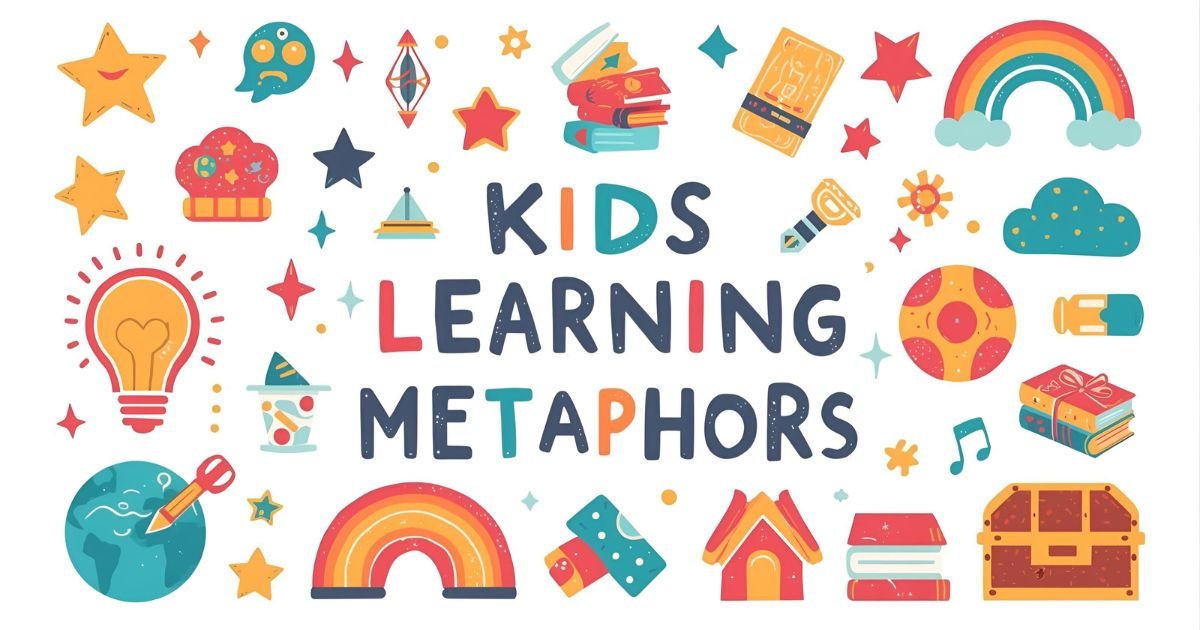
Metaphor for Kids sounds like a big, serious topic, but don’t worry. Let’s imagine we’re sitting together in class, and you ask me, “What even is a metaphor?” I’d smile and say, “It’s just a fun way to compare two things to make your sentence more exciting.” For example, if you say, “My brother is a monkey,” you don’t mean he has a tail, right? You mean he’s playful or silly. See? That’s a metaphor. It helps your writing feel colorful, creative, and full of imagination instead of plain and boring. And the best part? Once you understand it, you’ll start using metaphors everywhere without even trying.
Kids learn best when ideas feel real, familiar, and easy to imagine. And that’s exactly what metaphors do: they turn tricky concepts into pictures kids can instantly understand. So, let’s sit together for a minute and talk through some fun, kid-friendly metaphors your child can use and enjoy.
Think of this as us chatting across a table simple explanations, clear examples, and zero confusion. Ready? Let’s jump in.
20 Metaphors for Kids
1. “My backpack is a brick.”
Meaning: The backpack feels extremely heavy.
Explanation: Compares a backpack to a brick to show its weight.
Examples:
- “I could barely lift it—my backpack was a brick today.”
- “After adding my books, my bag turned into a brick.”
2. “Her smile is sunshine.”
Meaning: Her smile makes everything feel bright and happy.
Explanation: Sunshine symbolizes warmth and joy.
Examples:
- “Every morning, her smile is sunshine for the class.”
- “When she laughed, it was like sunshine filling the room.”
3. “The classroom was an oven.”
Meaning: The classroom felt very hot.
Explanation: Compares the heat of a room to the heat of an oven.
Examples:
- “By noon, the classroom was an oven.”
- “We opened the windows because the room was an oven.”
4. “He’s a walking encyclopedia.”
Meaning: He knows a lot of facts.
Explanation: Compares a knowledgeable person to a book of information.
Examples:
- “Ask Ali—he’s a walking encyclopedia.”
- “She’s a walking encyclopedia when it comes to space.”
5. “Her voice is music.”
Meaning: Her voice sounds pleasant.
Explanation: Music symbolizes beauty and harmony.
Examples:
- “Her voice is music when she reads stories.”
- “To the teacher, his polite answer was music.”
6. “The playground was a zoo.”
Meaning: It was loud and chaotic.
Explanation: Compares children’s noise to animals in a zoo.
Examples:
- “Recess started and the playground became a zoo.”
- “Before assembly, the hall was a zoo.”
7. “His words were daggers.”
Meaning: His words felt hurtful.
Explanation: Daggers symbolize emotional pain.
Examples:
- “When he insulted her, his words were daggers.”
- “Those rude comments were daggers to my heart.”
8. “Time is a thief.”
Meaning: Time passes quickly and takes moments away.
Explanation: Comparing time to a thief shows how fast it disappears.
Examples:
- “The weekend ended—time is a thief.”
- “Summer holidays vanished—time is a thief.”
9. “Her imagination is a rainbow.”
Meaning: She has colorful and creative ideas.
Explanation: Rainbows symbolize creativity and brightness.
Examples:
- “Her imagination is a rainbow when she draws.”
- “The stories she writes show her rainbow mind.”
10. “He’s a night owl.”
Meaning: He stays awake late.
Explanation: Compares a child to an owl known for being awake at night.
Examples:
- “He slept late again—he’s such a night owl.”
- “Night owls struggle to wake up early.”
11. “The test was a breeze.”
Meaning: The test was very easy.
Explanation: A breeze is gentle and effortless.
Examples:
- “Math was a breeze today.”
- “That quiz was a breeze compared to last week.”
12. “Her anger was a storm.”
Meaning: She was extremely angry.
Explanation: A storm represents strong, loud emotions.
Examples:
- “When she yelled, her anger was a storm.”
- “His storm of anger scared everyone.”
13. “He has a heart of gold.”
Meaning: He is very kind.
Explanation: Gold symbolizes purity and goodness.
Examples:
- “He shared his lunch—he has a heart of gold.”
- “Her heart of gold makes everyone love her.”
14. “The homework is a mountain.”
Meaning: The homework feels like too much.
Explanation: A mountain shows something large and overwhelming.
Examples:
- “My homework is a mountain tonight.”
- “Facing that project felt like climbing a mountain.”
15. “Her eyes were stars.”
Meaning: Her eyes looked bright and excited.
Explanation: Stars shine, symbolizing excitement or wonder.
Examples:
- “Her eyes were stars when she saw the cake.”
- “The gift made his eyes turn into stars.”
16. “The internet is a spiderweb.”
Meaning: Everything is connected.
Explanation: Like a web, the internet links information.
Examples:
- “The internet is a spiderweb of knowledge.”
- “People around the world connect in this digital spiderweb.”
17. “His laugh is thunder.”
Meaning: His laugh is very loud.
Explanation: Thunder shows booming, echoing sound.
Examples:
- “His laugh was thunder in the hall.”
- “The whole class heard his thunder laugh.”
18. “Books are treasure chests.”
Meaning: Books hold valuable knowledge.
Explanation: Treasure chests represent hidden riches.
Examples:
- “To her, books are treasure chests of adventures.”
- “Open a book—it’s a treasure chest.”
19. “My thoughts are butterflies.”
Meaning: Thoughts are moving quickly and freely.
Explanation: Butterflies symbolize light, fluttering movement.
Examples:
- “Before the test, my thoughts were butterflies.”
- “His ideas were butterflies, jumping everywhere.”
20. “The moon is a lantern.”
Meaning: The moon lights up the night.
Explanation: Compares the moon’s glow to a lantern’s brightness.
Examples:
- “The moon was a lantern guiding us home.”
- “At night, the sky’s lantern shone bright.”
FAQs
1. What is a metaphor in simple words?
A metaphor is when we say something is something else to make it more interesting. For example, “Time is a thief.”
2. Why do kids need to learn metaphors?
Metaphors make writing more creative, colorful, and fun to read. They help kids powerfully express ideas.
3. What is an example of a metaphor for kids?
“The classroom was a zoo.” This means the classroom was noisy and wild.
4. How is a metaphor different from a simile?
A metaphor says something is something else.
A simile uses “like” or “as” to compare (e.g., “busy as a bee”).
5. Are metaphors only used in stories?
No! Metaphors are used in poems, songs, conversations, and even everyday speech.
6. Can kids create their own metaphors?
Yes! Kids can use their imagination to compare two things in a fun and creative way.
7. Is a metaphor always true?
Not exactly. A metaphor is not meant to be taken literally—it’s used to create a picture in your mind.
8. How can metaphors improve writing skills?
They make sentences more descriptive, engaging, and expressive instead of plain and simple.
9. What is a fun activity to practice metaphors?
Try describing your friend, pet, or teacher using a creative comparison like “My dog is a fluffy cloud.”
10. Are metaphors hard to understand?
Not at all! Once you see a few examples, metaphors become easy and fun to use.
Conclusion:
Metaphors help kids understand ideas through simple pictures and comparisons, making learning more memorable and fun. With these 20 kid-friendly metaphors, children can boost creativity, improve writing, and express their thoughts more clearly. Encourage them to observe, imagine, and create their own metaphors. It’s one of the easiest ways to grow confident in language.