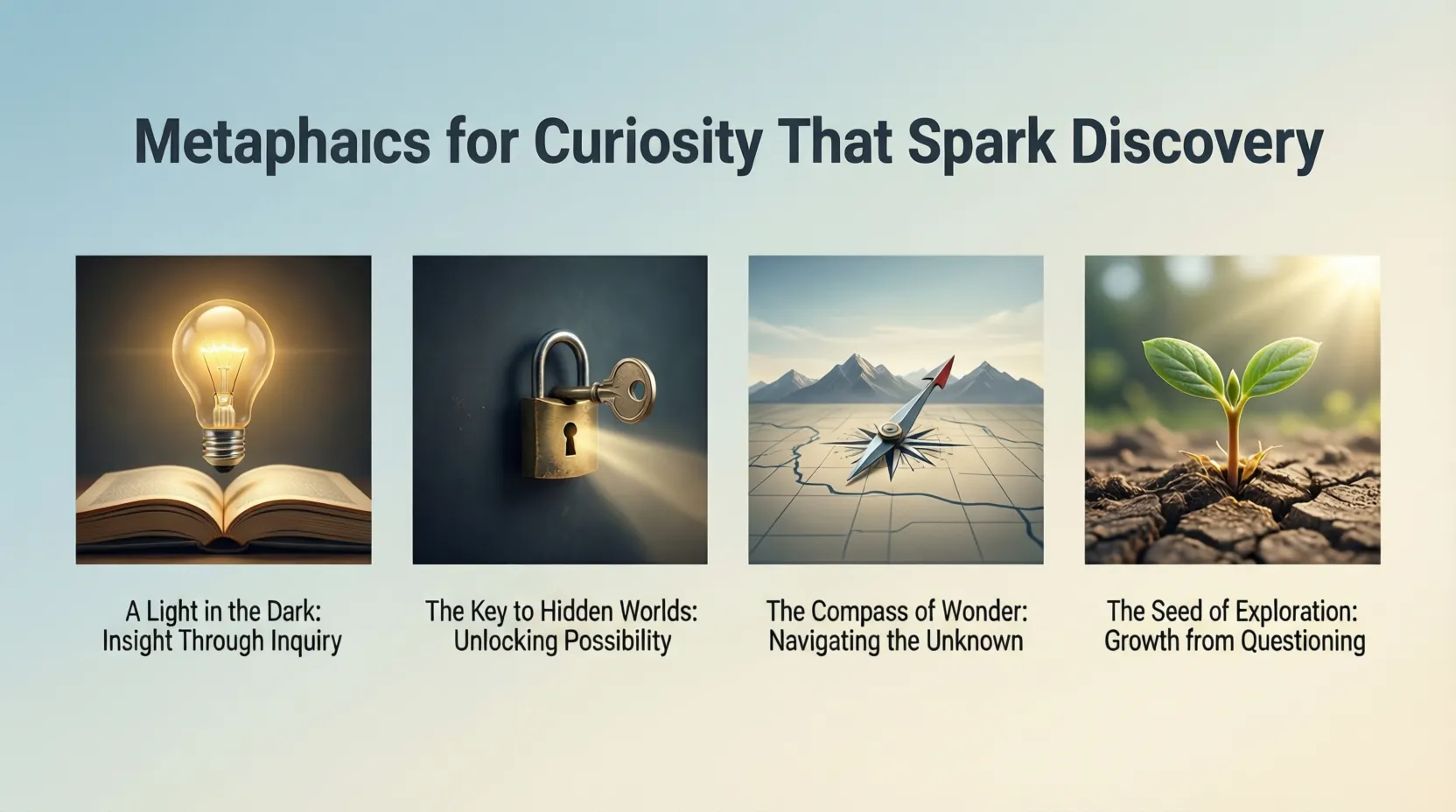
Metaphors for curiosity help students, teachers, and writers describe wonder, interest, and the urge to explore when simple words feel too plain. Sometimes, it’s frustrating to explain that restless need to ask questions or discover more without sounding repetitive or unclear. These metaphors turn curiosity into vivid, relatable images that readers instantly understand and feel.
On this page, you’ll discover creative ways to make your writing more expressive, engaging, and meaningful. Keep reading and let your words spark exploration, imagination, and the joy of curiosity itself!
20 Metaphors for Curiosity
1. Curiosity is a burning flame
Meaning: Strong desire to know
Explanation: Constantly pushes someone to learn more
Examples:
- Her curiosity was a burning flame that never faded.
- A burning flame of curiosity drove him to research deeply.
2. Curiosity is an open door
Meaning: Opportunity to discover
Explanation: Leads to new knowledge and experiences
Examples:
- Curiosity opened doors to new ideas.
- His questions were open doors to learning.
3. Curiosity is a wandering compass
Meaning: Desire to explore
Explanation: Guides someone toward discovery
Examples:
- Her curiosity acted like a wandering compass.
- A wandering compass led him into new subjects.
4. Curiosity is a hungry mind
Meaning: Constant need for information
Explanation: Always wants to learn more
Examples:
- She has a hungry mind for knowledge.
- His hungry mind absorbed every detail.
5. Curiosity is a spark
Meaning: Beginning of interest
Explanation: Starts learning and exploration
Examples:
- A spark of curiosity changed her path.
- His curiosity sparked a new passion.
6. Curiosity is a key
Meaning: Unlocks understanding
Explanation: Helps access deeper knowledge
Examples:
- Curiosity was the key to innovation.
- Questions became the key to understanding.
7. Curiosity is a river
Meaning: Continuous flow of questions
Explanation: Never stops moving forward
Examples:
- Curiosity flowed like a river in her mind.
- His river of curiosity never ran dry.
8. Curiosity is a flashlight
Meaning: Reveals hidden details
Explanation: Helps see what’s unseen
Examples:
- Curiosity worked like a flashlight in the darkness.
- A flashlight of curiosity revealed the truth.
9. Curiosity is an itch
Meaning: Uncomfortable need to know
Explanation: Cannot be ignored
Examples:
- Curiosity itched until he found answers.
- That question was an itch she had to scratch.
10. Curiosity is a treasure hunt
Meaning: Joyful exploration
Explanation: Learning feels exciting and rewarding
Examples:
- Research felt like a treasure hunt.
- Curiosity turned learning into a treasure hunt.
11. Curiosity is a pair of binoculars
Meaning: Focused observation
Explanation: Looks deeper into details
Examples:
- Curiosity gave her binoculars to see further.
- He used curiosity like binoculars.
12. Curiosity is a growing seed
Meaning: Developing interest
Explanation: Expands with care and attention
Examples:
- A seed of curiosity grew into passion.
- Teachers nurture seeds of curiosity.
13. Curiosity is a question mark
Meaning: Desire to understand
Explanation: Represents uncertainty and inquiry
Examples:
- His mind was full of question marks.
- Curiosity turned thoughts into question marks.
14. Curiosity is a trail of breadcrumbs
Meaning: Step-by-step discovery
Explanation: Leads gradually to understanding
Examples:
- Each answer left breadcrumbs for more questions.
- Curiosity followed a trail of breadcrumbs.
15. Curiosity is a window
Meaning: New perspective
Explanation: Allows viewing different ideas
Examples:
- Curiosity opened a window to the world.
- Books became windows through curiosity.
16. Curiosity is a restless engine
Meaning: Constant mental motion
Explanation: Keeps the mind active
Examples:
- His curiosity ran like a restless engine.
- A restless engine of curiosity drove her.
17. Curiosity is a lighthouse
Meaning: Guidance toward discovery
Explanation: Draws attention to new ideas
Examples:
- Curiosity acted as a lighthouse for learning.
- The topic became a lighthouse for her curiosity.
18. Curiosity is a magnet
Meaning: Attraction to knowledge
Explanation: Pulls information toward the learner
Examples:
- Curiosity pulled facts like a magnet.
- His mind was a magnet for ideas.
19. Curiosity is a map
Meaning: Direction for learning
Explanation: Guides exploration logically
Examples:
- Curiosity became a map for research.
- A map of curiosity led her studies.
20. Curiosity is in a child’s eyes
Meaning: Innocent wonder
Explanation: Pure desire to understand the world
Examples:
- He looked at life with a child’s eyes.
- Curiosity filled her with childlike wonder.
Practical Exercise
Questions & Answers
- Which metaphor shows curiosity starting learning?
Answer: Spark - Which metaphor represents constant questioning?
Answer: River - Which metaphor shows uncovering hidden information?
Answer: Flashlight - Which metaphor means curiosity cannot be ignored?
Answer: Itch - Which metaphor shows joyful exploration?
Answer: Treasure hunt - Which metaphor represents focused observation?
Answer: Binoculars - Which metaphor shows growing interest?
Answer: Growing seed - Which metaphor represents guidance in learning?
Answer: Map - Which metaphor shows attraction to knowledge?
Answer: Magnet - Which metaphor shows innocent wonder?
Answer: Child’s eyes
FAQs
1. Why use metaphors for curiosity?
They make learning and inquiry visual and engaging.
2. Are these metaphors suitable for students?
Yes, especially for essays and creative writing.
3. Can teachers use these metaphors?
Yes, to explain inquiry-based learning.
4. Are curiosity metaphors positive?
Mostly, as curiosity drives growth and discovery.
5. Can writers use them for characters?
Absolutely, they show inner motivation.
6. Are these metaphors formal?
They work in both academic and creative contexts.
7. Can curiosity metaphors inspire learning?
Yes, they make curiosity feel active and exciting.
8. Do these metaphors simplify complex ideas?
Yes, by turning abstraction into imagery.
9. Can they be used in speeches?
Yes, to motivate exploration and thinking.
10. How many metaphors should be used?
Use as many as needed without overwhelming the reader.
Conclusion:
Metaphors for curiosity help writers capture the excitement of discovery and the drive to learn. They turn abstract wonder into vivid images that reflect exploration, questioning, and growth. By using these metaphors, writing becomes more engaging and imaginative, inviting readers to share in the thrill of uncovering something new. If in storytelling, education, or reflective writing, metaphors for curiosity bring energy, movement, and a sense of endless possibility to ideas.