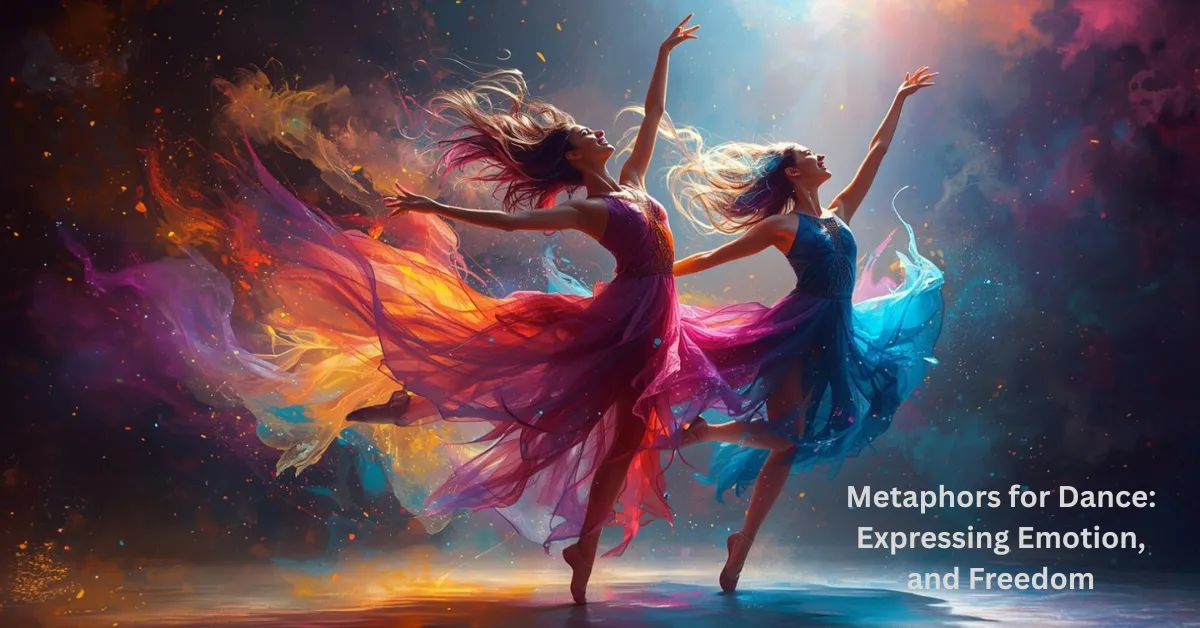
Metaphors for dance help describe movement, expression, and emotion in ways that simple words often cannot capture. Students often struggle to explain the beauty, rhythm, or energy of dance in essays. Writers want to show artistry and grace creatively, and teachers look for vivid examples that make abstract concepts relatable.
Simply saying “she dances gracefully” or “he moves well” can feel flat or repetitive, but metaphors bring dance to life. By comparing dance to flowing rivers, fluttering leaves, swirling winds, or poetic storytelling, you create imagery that readers can visualize and feel.
If writing stories, reflections, or creative pieces, using metaphors for dance adds depth, clarity, and emotional resonance, making movement unforgettable and expressive.
20 Metaphors for Dance
1. Dance is a river
Meaning: Flow and continuity
Explanation: Moves smoothly and endlessly
Examples:
Her movements flowed like a river.
The dancers glided across the stage like a river’s current.
2. Dance is fire
Meaning: Passion and energy
Explanation: Burns brightly and excites
Examples:
Their performance blazed like fire.
She danced with a fire that captivated everyone.
3. Dance is wind
Meaning: Freedom and movement
Explanation: Moves lightly and unpredictably
Examples:
Her skirt twirled like the wind.
The dancers moved like gusts of wind through the hall.
4. Dance is a story
Meaning: Narrative expression
Explanation: Tells emotions and events
Examples:
Each step told a story of love.
The dance was a story written in motion.
5. Dance is a flame
Meaning: Energy and inspiration
Explanation: Captivates attention and warms hearts
Examples:
Their energy burned like a flame.
Her passion for dance was a glowing flame.
6. Dance is a butterfly
Meaning: Grace and delicacy
Explanation: Moves lightly and beautifully
Examples:
She fluttered across the stage like a butterfly.
The dancers’ hands moved like butterflies in the air.
7. Dance is a wave
Meaning: Rhythm and motion
Explanation: Moves with ebb and flow
Examples:
The performance rose and fell like ocean waves.
Their steps flowed like waves on the shore.
8. Dance is a spark
Meaning: Inspiration and excitement
Explanation: Starts energy and movement
Examples:
Her first step sparked a chain of motion.
Each movement was a spark of creativity.
9. Dance is a flame of freedom
Meaning: Liberation
Explanation: Expresses inner emotions freely
Examples:
The dancers’ movements were a flame of freedom.
Her dance expressed freedom in every step.
10. Dance is a painting
Meaning: Visual expression
Explanation: Movements create colors and images
Examples:
Their performance painted emotions in the air.
Every gesture was a brushstroke of feeling.
11. Dance is a wind chime
Meaning: Musicality
Explanation: Movement produces sound and rhythm
Examples:
Her spins rang like a wind chime.
The dancers’ steps chimed like soft bells.
12. Dance is a river of light
Meaning: Beauty and continuity
Explanation: Flows gracefully and shines
Examples:
Their performance glowed like a river of light.
The dancers’ movements were fluid and bright.
13. Dance is a flame in the night
Meaning: Hope and inspiration
Explanation: Stands out and captivates
Examples:
The soloist shone like a flame in the night.
Her movements inspired like a candle in the darkness.
14. Dance is a breeze
Meaning: Lightness and ease
Explanation: Moves effortlessly
Examples:
She floated across the floor like a gentle breeze.
The dancers’ steps were as soft as a breeze.
15. Dance is a spiral
Meaning: Circular energy
Explanation: Moves dynamically and elegantly
Examples:
Her twirl formed a perfect spiral.
The dancers’ motions spiraled into the air.
16. Dance is a constellation
Meaning: Connection and beauty
Explanation: Steps connect like stars
Examples:
The ensemble shone like a constellation.
Every dancer formed a constellation of movement.
17. Dance is a wind of change
Meaning: Transformation
Explanation: Moves things emotionally and physically
Examples:
Her performance was a wind of change.
The dance shifted moods like a gust of wind.
18. Dance is a flame of emotion
Meaning: Emotional expression
Explanation: Reveals passion and feelings
Examples:
Every movement was a flame of emotion.
She danced her feelings into the room.
19. Dance is a river of stars
Meaning: Beauty and imagination
Explanation: Flows endlessly and captivates
Examples:
The stage sparkled as the dance flowed like a river of stars.
Her gestures created a river of stars in the audience’s imagination.
20. Dance is a mirror
Meaning: Reflection
Explanation: Shows inner self and culture
Examples:
Their dance mirrored traditions and feelings.
Every step reflected the dancer’s heart.
Practical Exercise:
| Question | Answer |
| Which metaphor shows fluidity? | River |
| Which metaphor shows passion? | Fire |
| Which metaphor shows freedom? | Wind |
| Which metaphor shows grace? | Butterfly |
| Which metaphor shows storytelling? | Story |
| Which metaphor shows inspiration? | Spark |
| Which metaphor shows lightness? | Breeze |
| Which metaphor shows visual beauty? | Painting |
| Which metaphor shows emotional expression? | Flame of emotion |
| Which metaphor shows reflection? | Mirror |
FAQs
- What are metaphors for dance?
They symbolically describe movement, emotion, freedom, and expression through performance. - Are these metaphors useful for essays?
Yes, they make writing about art, performance, and expression vivid and engaging. - Can students use them in exams?
Absolutely, especially for descriptive and narrative writing. - Do dance metaphors show emotion?
Yes, they reflect passion, freedom, beauty, and expression. - Can teachers use them in class?
Yes, for teaching arts, movement, and creative writing. - Are these metaphors flexible?
Yes, they work in essays, stories, speeches, and performance analysis. - Do metaphors improve writing quality?
Yes, they make abstract movement and emotions tangible. - Are they suitable for storytelling?
Definitely, they bring dance and emotion to life vividly. - Can writers adapt them?
Easily, for educational, literary, or creative contexts. - Do they help readers visualize dance?
Yes, metaphors make movement, rhythm, and emotion tangible.
Conclusion:
Metaphors for dance turn abstract movement, expression, and emotion into vivid, meaningful images. If dance is a river, fire, wind, or mirror, these metaphors help express beauty, freedom, and passion clearly. Strong writing begins when dance is not just described but fully visualized, and metaphors do exactly that.