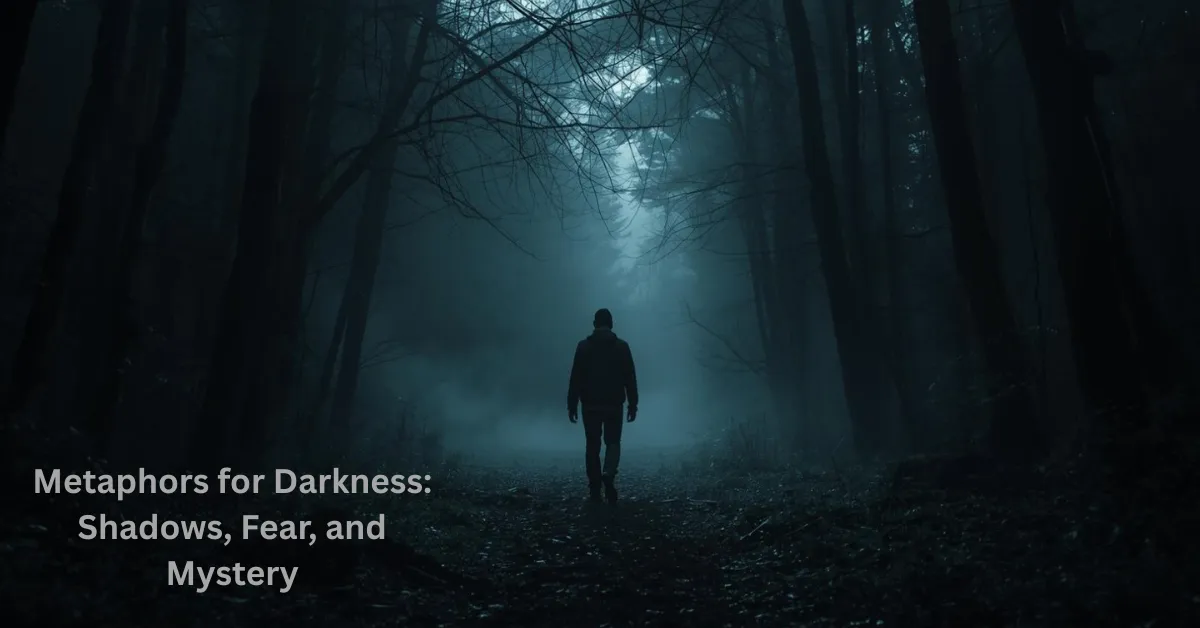
Metaphors for darkness help describe fear, mystery, and uncertainty in ways that simple words often cannot capture. Students often struggle to explain moods, emotions, or situations that feel shadowed or ominous in essays. Writers want to show tension and atmosphere creatively, and teachers look for vivid examples that make abstract concepts relatable.
Simply saying “it’s dark” or “I feel scared” can feel flat or repetitive, but metaphors bring darkness to life. By comparing darkness to heavy clouds, deep oceans, silent forests, or endless tunnels, you create imagery that readers can visualize and feel.
When writing stories, reflections, or analytical pieces, using metaphors for darkness adds depth, clarity, and emotional resonance, making the concept powerful and memorable.
20 Metaphors for Darkness
1. Darkness is a cave
Meaning: Isolation and mystery
Explanation: Hidden and enclosed space
Examples:
His mind felt like a dark cave.
The night was a cave with no light.
2. Darkness is a storm
Meaning: Turmoil
Explanation: Chaotic and threatening
Examples:
Fear rolled over him like a storm of darkness.
Darkness raged like a storm in the night.
3. Darkness is a shadow
Meaning: Concealment
Explanation: Hides objects or intentions
Examples:
The truth hid in the shadow of darkness.
Her fears lurked like shadows in darkness.
4. Darkness is a veil
Meaning: Obscurity
Explanation: Covers reality or clarity
Examples:
Darkness fell like a heavy veil.
A veil of darkness hid the path ahead.
5. Darkness is a blanket
Meaning: Enclosure
Explanation: Covers everything
Examples:
Night wrapped the town in a blanket of darkness.
The forest slept under a blanket of darkness.
6. Darkness is a void
Meaning: Emptiness
Explanation: Nothingness or absence
Examples:
The room was a void of darkness.
Her heart felt like a void of darkness.
7. Darkness is a tunnel
Meaning: Journey
Explanation: Path to unknown
Examples:
Life felt like walking through a tunnel of darkness.
The future was a long, dark tunnel.
8. Darkness is a mask
Meaning: Concealment of truth
Explanation: Hides intentions or emotions
Examples:
The darkness wore a mask of fear.
Secrets hid behind a mask of darkness.
9. Darkness is a cage
Meaning: Restriction
Explanation: Traps or limits
Examples:
He felt trapped in a cage of darkness.
Darkness imprisoned her thoughts.
10. Darkness is a stormy sea
Meaning: Uncertainty
Explanation: Turbulent and unpredictable
Examples:
Her emotions were a stormy sea of darkness.
The night stretched like a stormy sea.
11. Darkness is a shadowy forest
Meaning: Confusion and fear
Explanation: Hard to navigate
Examples:
He wandered through a shadowy forest of darkness.
Darkness loomed like trees in a shadowy forest.
12. Darkness is an eclipse
Meaning: Temporary concealment
Explanation: Hides light
Examples:
Hope was hidden behind an eclipse of darkness.
The eclipse brought darkness over the town.
13. Darkness is a thick fog
Meaning: Obscurity
Explanation: Hard to see through
Examples:
Her mind was a thick fog of darkness.
Darkness rolled in like a thick fog.
14. Darkness is a black hole
Meaning: Consuming emptiness
Explanation: Draws everything into itself
Examples:
Fear pulled him into a black hole of darkness.
Her sorrow was a black hole of darkness.
15. Darkness is a night without stars
Meaning: Hopelessness
Explanation: Complete absence of guidance
Examples:
It was a night without stars, full of darkness.
Darkness gave no light, like a starless night.
16. Darkness is a shadow of doubt
Meaning: Uncertainty
Explanation: Conceals clarity or truth
Examples:
His mind was a shadow of doubt in darkness.
The darkness of doubt clouded her judgment.
17. Darkness is a forest at midnight
Meaning: Fear and mystery
Explanation: Dense and intimidating
Examples:
He walked like a lone traveler in a forest at midnight.
The darkness felt like a forest at midnight.
18. Darkness is a silent enemy
Meaning: Threat
Explanation: Hides danger
Examples:
Darkness approached like a silent enemy.
Fear lurked in the silent enemy of darkness.
19. Darkness is a veil over truth
Meaning: Concealment
Explanation: Prevents seeing clearly
Examples:
The secret lay beneath a veil of darkness.
Truth hid under a veil of darkness.
20. Darkness is a heavy stone
Meaning: Burden
Explanation: Presses on and weighs down
Examples:
Her sorrow was a heavy stone of darkness.
Darkness weighed on him like a stone.
Practical Exercise:
| Question | Answer |
| Which metaphor shows isolation? | Cave |
| Which metaphor shows turmoil? | Storm |
| Which metaphor shows concealment? | Shadow |
| Which metaphor shows emptiness? | Void |
| Which metaphor shows restriction? | Cage |
| Which metaphor shows uncertainty? | Stormy sea |
| Which metaphor shows fear? | Shadowy forest |
| Which metaphor shows hopelessness? | Night without stars |
| Which metaphor shows burden? | Heavy stone |
| Which metaphor shows concealment of truth? | Veil over truth |
FAQs
- What are metaphors for darkness?
They symbolically describe fear, mystery, uncertainty, and negativity. - Are these metaphors useful for essays?
Yes, especially for descriptive, reflective, and literary writing. - Can students use them in exams?
Absolutely, they make abstract ideas clear and relatable. - Do darkness metaphors show emotion?
Yes, they reflect fear, mystery, burden, and confusion vividly. - Can teachers use them in class?
Yes, for teaching descriptive writing and literary analysis. - Are these metaphors flexible?
Yes, they can be adapted for essays, stories, poetry, and speeches. - Do metaphors improve writing quality?
Yes, they make abstract or unseen concepts tangible. - Are they suitable for storytelling?
Definitely, they create vivid imagery and mood. - Can writers adapt them?
Easily, for literary, educational, or creative contexts. - Do they help readers visualize darkness?
Yes, metaphors make mystery, fear, and uncertainty tangible.
Conclusion:
Metaphors for darkness turn abstract fear, mystery, and uncertainty into vivid, meaningful images. If darkness is a cave, storm, veil, or heavy stone, these metaphors help express complexity, fear, and emotional weight clearly. Strong writing begins when darkness is not just described but truly felt, and metaphors do exactly that.