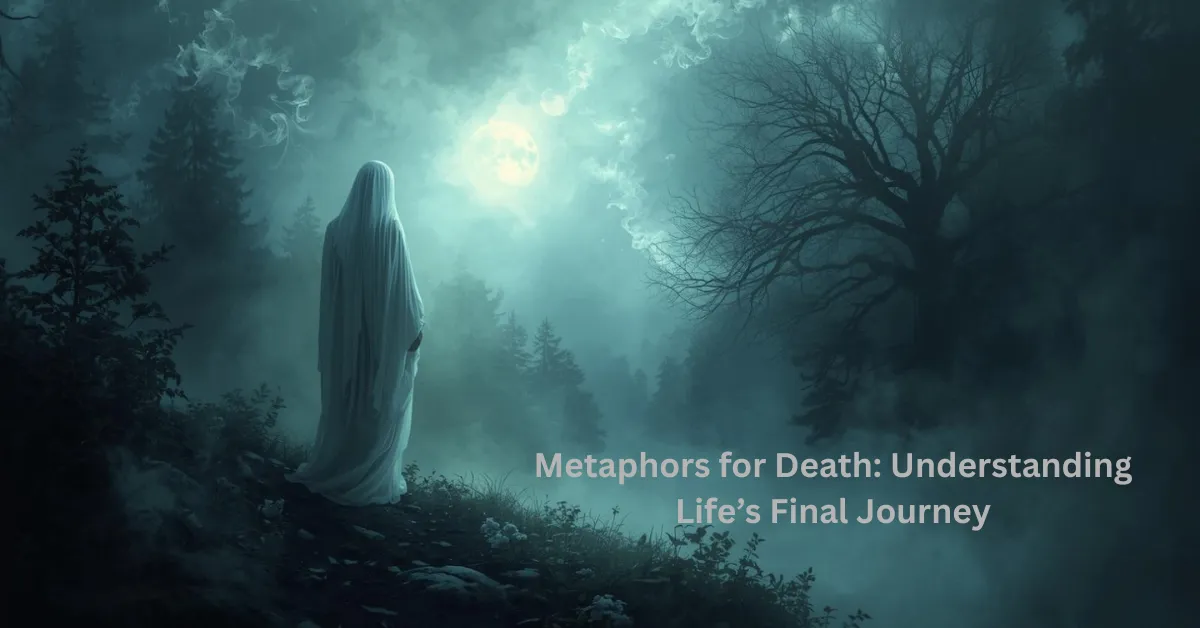
Metaphors for death help describe the end of life, loss, and transition in ways that simple words often cannot capture. Students often struggle to explain mortality in essays, writers want to show grief, closure, or transformation creatively, and teachers look for vivid examples that make abstract concepts relatable.
Simply saying “someone died” or “he passed away” can feel flat or impersonal, but metaphors bring the concept of death to life. By comparing death to falling leaves, setting suns, closing doors, or passing seasons, you create imagery that readers can visualize and feel.
If writing stories, reflections, or analytical pieces, using metaphors for death adds depth, clarity, and emotional resonance, making the idea of mortality more profound and memorable.
20 Metaphors for Death
1. Death is a journey
Meaning: Transition
Explanation: Moves from life to the unknown
Examples:
Death is a journey to another realm.
He viewed death as a journey beyond the stars.
2. Death is a door
Meaning: Passage
Explanation: Leads to a new state
Examples:
Death is a door we all must walk through.
The old man saw death as a quiet door.
3. Death is sleep
Meaning: Rest and peace
Explanation: Life pauses, body rests
Examples:
He fell into death like sleep.
Death gave her eternal rest like a gentle sleep.
4. Death is a shadow
Meaning: Inevitable presence
Explanation: Always follows life
Examples:
Death lingers like a shadow.
The shadow of death passed quietly.
5. Death is a river
Meaning: Continuous flow
Explanation: Life flows toward the end
Examples:
Life flowed into the river of death.
Death carried him like a river to the sea.
6. Death is a curtain
Meaning: Separation
Explanation: Hides the world of the living
Examples:
Death draws a curtain over life.
Behind the curtain of death lies silence.
7. Death is a thief
Meaning: Loss
Explanation: Takes life unexpectedly
Examples:
Death stole him like a thief in the night.
Life was taken quietly by the thief called death.
8. Death is a storm
Meaning: Turmoil
Explanation: Powerful and uncontrollable
Examples:
Death struck like a sudden storm.
Life ended in the storm of death.
9. Death is a bridge
Meaning: Transition
Explanation: Connects life and the afterlife
Examples:
Death is a bridge to another world.
Crossing the bridge of death is the final journey.
10. Death is a garden
Meaning: Renewal
Explanation: Life continues in memory or nature
Examples:
Death is a garden where memories bloom.
The forest reminded her that death feeds new life.
11. Death is a flame
Meaning: Finality
Explanation: Burns life to its end
Examples:
Death consumed him like a flame.
Life flickered out in the flame of death.
12. Death is a voyage
Meaning: Exploration
Explanation: Moves into unknown realms
Examples:
He sailed on the voyage of death.
Death is the final voyage we all undertake.
13. Death is a winter
Meaning: Endings
Explanation: Life stops and rests
Examples:
Her life ended like winter.
Death brought the silence of a cold winter.
14. Death is a gate
Meaning: Passage
Explanation: Entry to the unknown
Examples:
Death is the gate beyond our understanding.
He approached the gate of death calmly.
15. Death is a shadowed path
Meaning: Mystery
Explanation: Uncertain and dark
Examples:
The old path led to a shadowed path of death.
Death’s path is shadowed and quiet.
16. Death is a whisper
Meaning: Silence
Explanation: Subtle and inevitable
Examples:
Death came like a whisper in the night.
Life ended softly with the whisper of death.
17. Death is a tide
Meaning: Natural force
Explanation: Life flows into it inevitably
Examples:
All life meets the tide of death.
Death pulled him in like the ocean tide.
18. Death is a veil
Meaning: Separation
Explanation: Divides the living and the gone
Examples:
The veil of death hid her from the world.
Death’s veil separated him from loved ones.
19. Death is a book closing
Meaning: Ending
Explanation: Life story completes
Examples:
Death closed the book of his life.
Her story ended with the closing of life’s book.
20. Death is a shadowed sky
Meaning: Darkness and mystery
Explanation: Unknown and all-encompassing
Examples:
Death spread like a shadowed sky.
The sky of death covered the world in silence.
Practical Exercise:
| Question | Answer |
| Which metaphor shows transition? | Journey |
| Which metaphor shows rest? | Sleep |
| Which metaphor shows inevitability? | Shadow |
| Which metaphor shows loss? | Thief |
| Which metaphor shows passage? | Door |
| Which metaphor shows mystery? | Shadowed path |
| Which metaphor shows finality? | Flame |
| Which metaphor shows renewal? | Garden |
| Which metaphor shows ending? | Book closing |
| Which metaphor shows natural force? | Tide |
FAQs
- What are metaphors for death?
They symbolically describe endings, loss, transition, and mortality. - Are these metaphors useful for essays?
Yes, they enhance descriptive, reflective, and literary writing. - Can students use them in exams?
Absolutely, they make abstract ideas more vivid and meaningful. - Do death metaphors show emotion?
Yes, they reflect grief, mystery, inevitability, and reflection. - Can teachers use them in class?
Yes, for teaching literature, philosophy, and creative writing. - Are these metaphors flexible?
Yes, they fit essays, stories, poetry, and speeches. - Do metaphors improve writing quality?
Yes, they make abstract concepts tangible and emotionally resonant. - Are they suitable for storytelling?
Definitely, they create imagery that captures life and death. - Can writers adapt them?
Easily, for creative, literary, or educational contexts. - Do they help readers visualize death?
Yes, metaphors make the abstract, inevitable, and emotional aspects of death tangible.
Conclusion:
Metaphors for death turn the abstract concept of endings, mortality, and transition into vivid, meaningful images. If death is a journey, a door, a shadow, or a book closing, these metaphors help express finality, mystery, and reflection clearly. Strong writing begins when death is not just described but deeply visualized, and metaphors do exactly that.