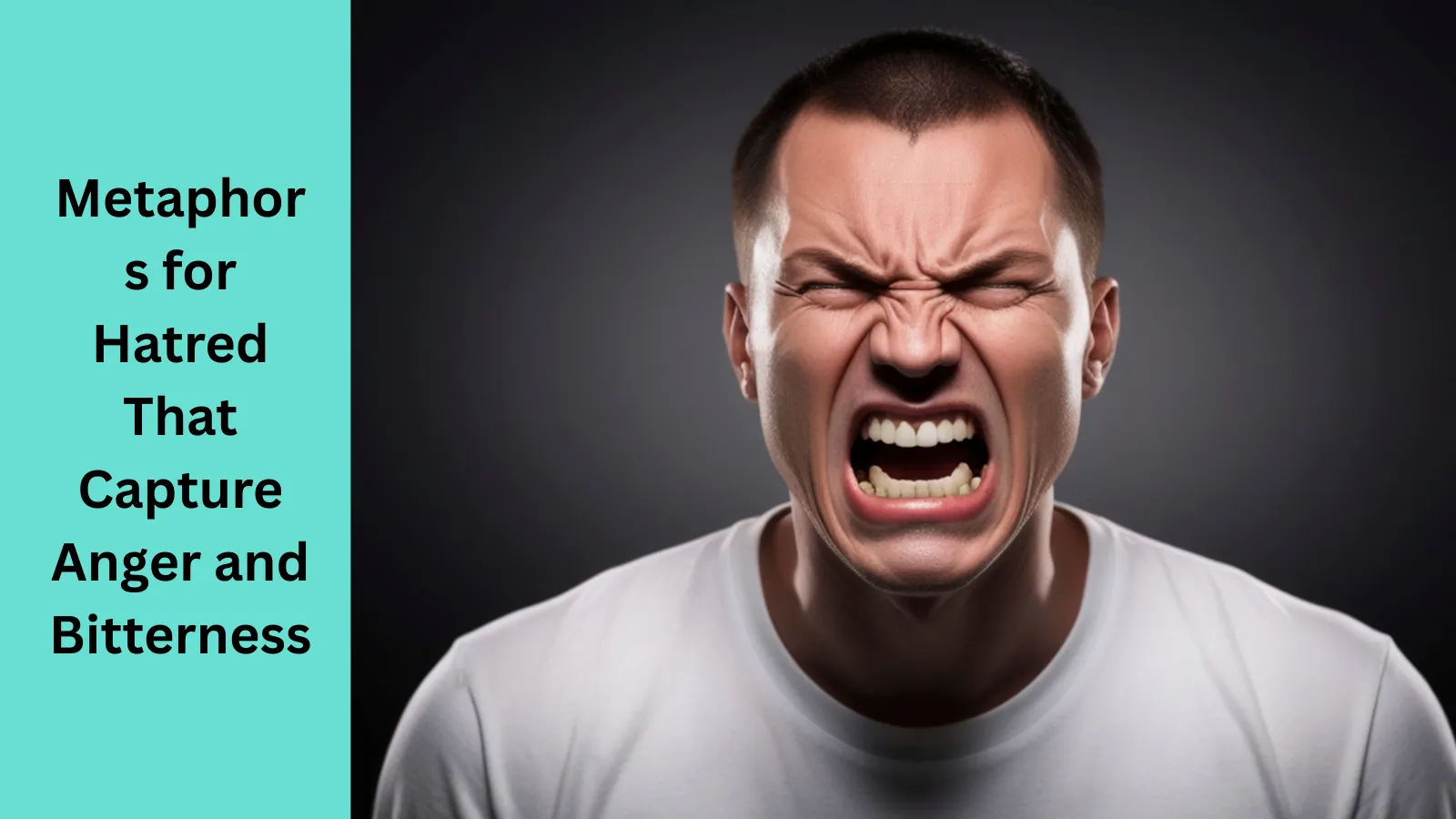
Metaphors for hatred help students, teachers, and writers express anger, resentment, and intense dislike when plain words feel too weak or harsh. Sometimes, it’s difficult to capture the depth and intensity of negative emotions without sounding repetitive or flat.
These metaphors turn hatred into vivid, relatable images that readers instantly understand and feel. On this page, you’ll discover creative ways to make your writing more expressive, powerful, and emotionally impactful. Keep reading and let your words convey the raw intensity, conflict, and fire of hatred with clarity and strength!
20 Metaphors for Hatred
1. Hatred is a burning fire
Meaning: Intense anger
Explanation: Jalti hui nafrat jo sab kuch consume kar de
Examples:
- His hatred burned like a fire.
- The feud between them was a burning fire.
2. Hatred is a poisonous snake
Meaning: Dangerous resentment
Explanation: Silent but deadly animosity
Examples:
- Hatred coiled like a poisonous snake.
- His words struck like a venomous bite.
3. Hatred is a dark storm
Meaning: Turmoil and chaos
Explanation: Emotional upheaval
Examples:
- Hatred raged like a dark storm.
- Conflict grew like a storm overhead.
4. Hatred is a thorny vine
Meaning: Entangling and persistent
Explanation: Keeps holding and spreading
Examples:
- Their rivalry grew like a thorny vine.
- Anger wrapped around him like thorns.
5. Hatred is a frozen heart
Meaning: Lack of compassion
Explanation: Emotional coldness
Examples:
- His betrayal left me with a frozen heart.
- Hatred made her feel numb inside.
6. Hatred is a grinding wheel
Meaning: Destructive force
Explanation: Slowly wearing down someone or something
Examples:
- Grudges acted like a grinding wheel.
- Hatred wore down their friendship.
7. Hatred is a raging river
Meaning: Unstoppable intensity
Explanation: Flow of uncontrollable emotion
Examples:
- His hatred flowed like a raging river.
- Conflict swept through the city like a river.
8. Hatred is a shadow that lingers
Meaning: Persistent negativity
Explanation: Follow you everywhere
Examples:
- Hatred stayed like a lingering shadow.
- The memory of betrayal cast a shadow over him.
9. Hatred is a coiled spring
Meaning: Potentially explosive
Explanation: Can erupt anytime
Examples:
- Her anger was a coiled spring.
- Hatred waited to snap.
10. Hatred is a venomous fog
Meaning: All-consuming and toxic
Explanation: Spreads everywhere
Examples:
- Hatred enveloped the room like a venomous fog.
- Gossip created a venomous fog in the office.
11. Hatred is a grinding storm
Meaning: Relentless conflict
Explanation: Harsh, continuous attack
Examples:
- Their argument was a grinding storm.
- Hatred persisted like an unending storm.
12. Hatred is a shattered mirror
Meaning: Fragmented perception
Explanation: Distorts reality
Examples:
- Hatred reflected like a shattered mirror.
- Their view of each other was distorted.
13. Hatred is a caged beast
Meaning: Suppressed rage
Explanation: Waiting to be unleashed
Examples:
- Hatred lurked like a caged beast.
- Anger waited inside him, ready to strike.
14. Hatred is a burning coal
Meaning: Smoldering resentment
Explanation: May flare up at any time
Examples:
- His grudge was a burning coal.
- Hatred simmered quietly until provoked.
15. Hatred is a venomous plant
Meaning: Grows quickly and damages
Explanation: Spreads toxicity
Examples:
- Gossip acted like a venomous plant.
- Hatred strangled relationships like vines.
16. Hatred is a frozen wasteland
Meaning: Desolate emotion
Explanation: Cold and empty feeling
Examples:
- After betrayal, his soul felt like a frozen wasteland.
- Hatred left the room cold and lifeless.
17. Hatred is a crashing wave
Meaning: Sudden outburst
Explanation: Powerful, overwhelming emotion
Examples:
- His rage hit like a crashing wave.
- Hatred engulfed her like a wave.
18. Hatred is a stormy sea
Meaning: Chaotic and dangerous
Explanation: Turbulent emotion
Examples:
- Hatred tossed his mind like a stormy sea.
- Conflict churned like a stormy sea.
19. Hatred is a biting frost
Meaning: Cold and painful emotion
Explanation: Leaves emotional wounds
Examples:
- Their words were a biting frost.
- Hatred froze the warmth of friendship.
20. Hatred is a black hole
Meaning: Consumes everything
Explanation: Leaves nothing positive behind
Examples:
- Hatred devoured their relationship like a black hole.
- Negativity pulled everyone in like a black hole.
Practical Exercise
Questions & Answers
- Which metaphor shows intense burning emotion?
Answer: Burning fire - Which metaphor represents dangerous and silent resentment?
Answer: Poisonous snake - Which metaphor shows persistent negativity?
Answer: Shadow that lingers - Which metaphor shows suppressed rage?
Answer: Caged beast - Which metaphor shows overwhelming destruction?
Answer: Black hole - Which metaphor shows distorted perception?
Answer: Shattered mirror - Which metaphor shows rapidly growing toxicity?
Answer: Venomous plant - Which metaphor shows cold and painful emotion?
Answer: Biting frost - Which metaphor shows uncontrollable emotion?
Answer: Raging river - Which metaphor shows sudden overwhelming emotion?
Answer: Crashing wave
FAQs
1. What are metaphors for hatred?
They describe strong negative emotions using vivid imagery.
2. Why use metaphors instead of “hate”?
They make emotion more visual, relatable, and impactful.
3. Can students use them in essays?
Yes, especially for descriptive or narrative essays.
4. Are these metaphors formal or creative?
They work well in both contexts.
5. Can teachers use these?
Yes, for teaching figurative language.
6. Can hatred symbolize broader issues?
Yes—conflict, jealousy, or resentment.
7. Are these suitable for storytelling?
Perfect for drama and tension.
8. Do metaphors exaggerate emotions?
They illustrate intensity without exaggeration.
9. Can these be used in speeches?
Yes, to create a strong emotional impact.
10. How many metaphors should be used?
Use only those that clarify or enhance understanding.
Conclusion:
Metaphors for hatred help writers give form to one of the strongest human emotions. They turn anger, bitterness, and hostility into vivid images that readers can immediately feel. By using these metaphors, writing becomes more intense, honest, and emotionally charged. If describing personal conflict, deep resentment, or inner struggle, metaphors for hatred allow writers to communicate the destructive power of hate clearly and memorably.