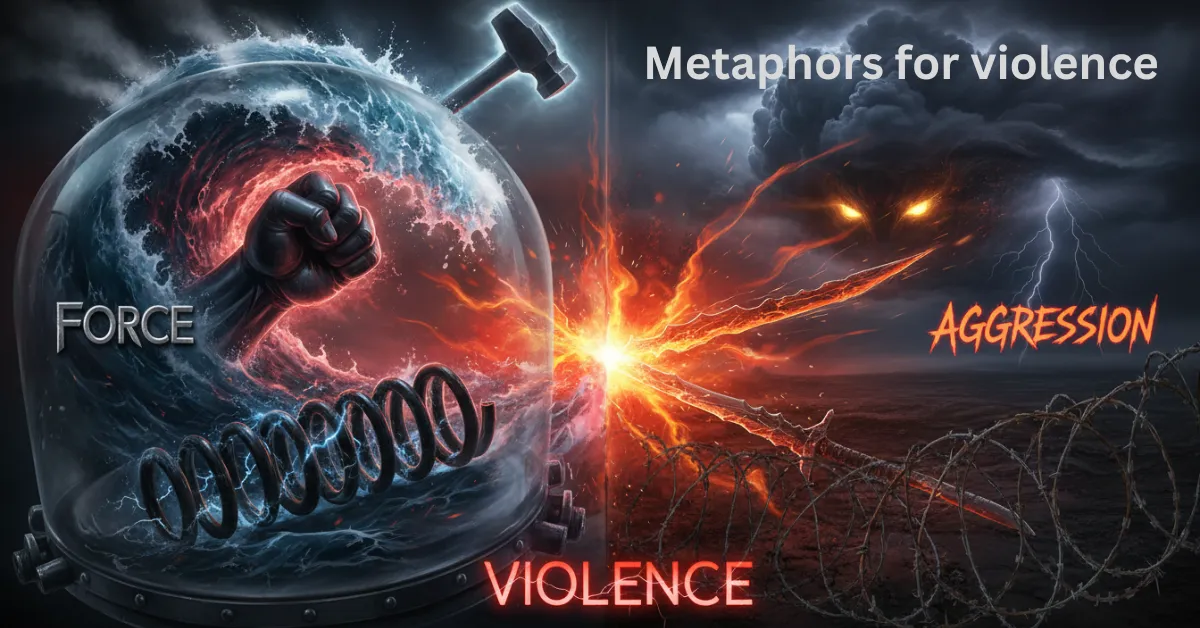
Metaphors for violence help describe aggression, conflict, and destruction in ways that ordinary words often cannot capture. Students often struggle to explain the intensity or impact of violent actions in essays. Writers want to show tension and danger creatively, and teachers look for vivid examples that make abstract concepts tangible.
Simply saying “violence” or “aggression” can feel flat or repetitive, but metaphors bring the idea to life. By comparing violence to storms, wildfires, crashing waves, or erupting volcanoes, you create imagery that readers can feel and visualize.
If writing stories, reflections, or analytical pieces, using metaphors for violence adds depth, clarity, and emotional impact, making the depiction of conflict more powerful and memorable.
20 Metaphors for Violence
1. Violence is a storm
Meaning: Sudden and intense
Explanation: Overwhelms quickly and destructively
Examples:
The riot hit like a violent storm.
Violence swept through the city like a storm.
2. Violence is fire
Meaning: Destructive energy
Explanation: Burns and consumes everything in its path
Examples:
The clash erupted as violence fire.
Anger burned like fire in the violent fight.
3. Violence is a battlefield
Meaning: Conflict and struggle
Explanation: Structured combat and struggle for dominance
Examples:
The protest became a violent battlefield.
Their clash resembled a battlefield of aggression.
4. Violence is an earthquake
Meaning: Shocking and destabilizing
Explanation: Shakes foundations and causes upheaval
Examples:
The attack struck like a violent earthquake.
Violent acts shook the community like an earthquake.
5. Violence is a tornado
Meaning: Chaos and force
Explanation: Spreads unpredictably with destruction
Examples:
The fight spun like a violent tornado.
Anger moved like a tornado of violence.
6. Violence is a knife
Meaning: Sharp and direct
Explanation: Cuts deeply and precisely
Examples:
His words struck like a violent knife.
The assault cut through the peace like a knife.
7. Violence is a wave
Meaning: Overwhelming power
Explanation: Washes over everything in its path
Examples:
The mob surged like a violent wave.
Anger came crashing like a wave of violence.
8. Violence is a firestorm
Meaning: Intense and consuming
Explanation: Multiplies destruction rapidly
Examples:
The riot became a firestorm of violence.
The protest turned into a firestorm of chaos.
9. Violence is a hammer
Meaning: Blunt and forceful
Explanation: Strikes with strength
Examples:
The dictator ruled like a hammer of violence.
Brutality hit like a hammer in the violent attack.
10. Violence is a jungle
Meaning: Wild and uncontrolled
Explanation: Survival of the strongest, chaotic
Examples:
The streets became a jungle of violence.
The gang fought like predators in a violent jungle.
11. Violence is a tornado of words
Meaning: Aggressive speech
Explanation: Rapidly attacking and overwhelming verbally
Examples:
The debate turned into a tornado of violent words.
Anger and insults flew like a tornado of violence.
12. Violence is a stormy sea
Meaning: Turbulent and uncontrollable
Explanation: Swells of aggression and danger
Examples:
The city descended into a stormy sea of violence.
Conflict churned like a stormy sea.
13. Violence is a snake
Meaning: Sneaky and harmful
Explanation: Strikes unexpectedly
Examples:
The betrayal came like a snake of violence.
Danger slithered silently like a violent snake.
14. Violence is a wildfire
Meaning: Rapid spread
Explanation: Difficult to contain, destructive
Examples:
The fight spread like a wildfire of violence.
Chaos burned like wildfire in the violent riot.
15. Violence is a cannon
Meaning: Powerful and loud
Explanation: Delivers force abruptly
Examples:
The attack struck like a cannon of violence.
Blows came like a violent cannon.
16. Violence is a storm of fists
Meaning: Physical aggression
Explanation: Repeated blows with force
Examples:
The brawl was a storm of violent fists.
His punches rained like a storm of violence.
17. Violence is a wave of rage
Meaning: Emotional and physical force
Explanation: Sweeps over people with anger
Examples:
The mob surged like a wave of violent rage.
Rage came crashing like a violent wave.
18. Violence is a hammer of oppression
Meaning: Brutal authority
Explanation: Enforces power harshly
Examples:
The dictator ruled with a hammer of violence.
Oppression struck like a violent hammer.
19. Violence is a cage fight
Meaning: Confined but intense
Explanation: Conflict occurs in a restricted space
Examples:
The riot felt like a cage fight of violence.
Street clashes were like violent cage fights.
20. Violence is a whirlwind
Meaning: Chaotic and overwhelming
Explanation: Moves unpredictably, leaving destruction
Examples:
The attack spun like a whirlwind of violence.
Violence tore through the city like a whirlwind.
Practical Exercise:
| Question | Answer |
| Which metaphor shows sudden and intense impact? | Storm |
| Which metaphor shows destructive energy? | Fire |
| Which metaphor shows chaotic movement? | Tornado |
| Which metaphor shows unpredictability? | Whirlwind |
| Which metaphor shows sharpness? | Knife |
| Which metaphor shows rapid spread? | Wildfire |
| Which metaphor shows controlled power? | Hammer |
| Which metaphor shows emotional aggression? | Wave of rage |
| Which metaphor shows wildness? | Jungle |
| Which metaphor shows confined intensity? | Cage fight |
FAQs
- What are metaphors for violence?
They symbolically describe aggression, force, and conflict. - Are these useful for essays?
Yes, especially for descriptive, analytical, or reflective writing. - Can students use them in exams?
Yes, they enhance imagery, clarity, and expression. - Do violence metaphors show intensity?
Absolutely, they highlight danger, power, and unpredictability. - Can teachers use them in class?
Yes, for creative writing, discussions, or analyzing conflict. - Are these metaphors flexible?
Yes, they work in essays, stories, speeches, and poetry. - Do metaphors improve writing quality?
Yes, they make aggression and conflict vivid and relatable. - Are they suitable for storytelling?
Yes, they depict intensity, danger, and unpredictability effectively. - Can writers adapt them?
Easily, for personal, educational, or creative contexts. - Do they help readers visualize violence?
Yes, metaphors make force, conflict, and aggression tangible.
Conclusion:
Metaphors for violence turn abstract ideas of aggression, conflict, and destruction into vivid images. If violence is a storm, wildfire, whirlwind, or battlefield, these metaphors help express intensity, danger, and chaos clearly. Strong writing begins when violence is not just described but fully visualized, and metaphors do exactly that.