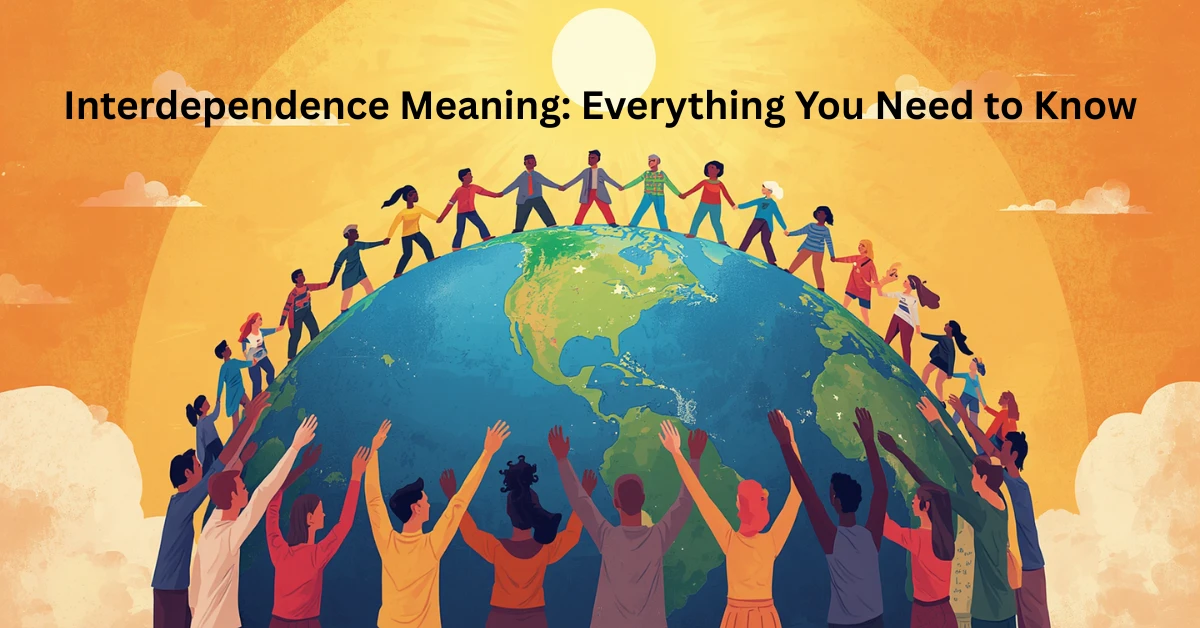
The Interdependence meaning refers to the relationship in which two or more people, groups, organisms, or systems rely on one another for support, resources, or success. The concept is commonly discussed in economics, ecology, sociology, business, and everyday life to explain how individuals and communities are connected through mutual dependence. Rather than functioning in isolation, interdependent relationships highlight the importance of cooperation, shared responsibility, and collaboration. Understanding the meaning of interdependence can help you better interpret academic concepts and recognize how interconnected our world truly is. In this guide, you’ll learn what interdependence means, its origins, examples, significance, and how it applies to different aspects of life.
In today’s interconnected world, no person, business, or nation truly exists in isolation. From the food we eat and the technology we use to the relationships we build and the economies that shape our lives, everything is linked in some way. This concept is known as interdependence. Understanding the interdependence meaning can help us appreciate how cooperation, mutual support, and shared responsibilities contribute to success and stability in everyday life.
Whether you’re studying economics, biology, sociology, or simply trying to understand how society functions, the idea of interdependence appears everywhere. It explains why countries trade with one another, why ecosystems remain balanced, and why teamwork often leads to better outcomes than individual effort alone.
In this comprehensive guide, we’ll explore the meaning of interdependence, its origins, examples, benefits, misconceptions, and practical applications. By the end of this article, you’ll understand why interdependence is one of the most important concepts shaping our modern world.
Interdependence Meaning: Quick Answer
Interdependence means a relationship in which two or more people, groups, organizations, or systems depend on one another for support, resources, or success.
Simple Definition
Interdependence is mutual dependence—where individuals or groups rely on each other to function effectively.
Example
Farmers grow crops, truck drivers transport food, grocery stores sell products, and consumers purchase them. Each plays an essential role in the larger system.
What Does Interdependence Mean?
At its core, interdependence refers to mutual reliance.
Unlike complete independence, where people function entirely on their own, interdependence recognizes that cooperation and collaboration are often necessary.
Key Characteristics of Interdependence
- Mutual support
- Shared responsibility
- Cooperation
- Resource exchange
- Connected outcomes
- Reciprocal relationships
Everyday Explanation
Think about a soccer team.
Each player has a different role:
- Goalkeeper
- Defenders
- Midfielders
- Forwards
Success depends on everyone working together rather than one person doing everything alone.
That’s interdependence in action.
Origin and History of Interdependence
Understanding the history of the word makes its meaning clearer.
Word Origin
The term combines two parts:
| Part | Meaning |
| Inter | Between or among |
| Dependence | Reliance or need |
Together, they mean:
“Depending upon one another.”
Historical Development
The concept has long existed in human societies.
Historically, communities relied on shared labor for:
- Farming
- Trade
- Defense
- Childcare
- Construction
As civilizations grew, interdependence expanded into economics, politics, and global relations.
Interdependence vs Independence vs Dependence
People often confuse these terms.
Key Differences
| Concept | Meaning | Example |
| Independence | Self-reliance | Living without help |
| Dependence | Relying on others | A child relying on parents |
| Interdependence | Mutual reliance | Team members supporting each other |
Simple Example
Independence
“I do everything myself.”
Dependence
“I rely entirely on someone else.”
Interdependence
“We support each other and work together.”
Why Is Interdependence Important?
Interdependence contributes to stability, efficiency, and growth.
1. Encourages Cooperation
People achieve more together than alone.
2. Promotes Specialization
Individuals focus on their strengths.
3. Builds Strong Relationships
Mutual support strengthens trust.
4. Increases Productivity
Collaboration often improves outcomes.
5. Supports Innovation
Sharing ideas leads to creativity.
Examples of Interdependence in Everyday Life
Interdependence exists all around us.
Family Relationships
Parents support children.
Children contribute love, companionship, and eventually assistance.
Friendships
Friends rely on one another emotionally and socially.
Schools
Teachers educate students.
Students participate and learn.
Administrators maintain systems.
Communities
Residents support local businesses.
Businesses provide goods and services.
Workplaces
Employees depend on colleagues to complete projects successfully.
Interdependence in Economics
One of the most important applications appears in economics.
Economic Interdependence Meaning
Economic interdependence occurs when countries, businesses, or individuals rely on each other for goods, services, and resources.
Examples
- Countries importing oil
- Businesses using international suppliers
- Consumers buying foreign products
Benefits
- Access to resources
- Lower production costs
- Expanded markets
- Increased trade opportunities
Global Interdependence
Modern globalization has strengthened interdependence worldwide.
How Countries Depend on Each Other
Countries exchange:
- Food
- Technology
- Energy
- Medical supplies
- Raw materials
- Knowledge
Example
A smartphone may involve:
- Design in one country
- Components from another
- Assembly elsewhere
- Global distribution
This illustrates how interconnected the world has become.
Interdependence in Ecology
Nature provides some of the clearest examples.
Ecosystem Interdependence
Living organisms rely on one another for survival.
Examples
Bees and Flowers
- Bees collect nectar.
- Flowers receive pollination.
Both benefit.
Predators and Prey
Population balance supports ecosystem health.
Plants and Humans
Plants produce oxygen.
Humans release carbon dioxide.
Interdependence in Relationships
Healthy relationships often involve interdependence.
Characteristics
- Mutual respect
- Emotional support
- Shared goals
- Personal autonomy
- Open communication
Important Note
Interdependence differs from unhealthy dependence because both individuals maintain their identities while supporting one another.
Benefits of Interdependence
Interdependence offers numerous advantages.
Improved Problem-Solving
Different perspectives generate better solutions.
Emotional Support
People feel connected and valued.
Resource Sharing
Communities use resources efficiently.
Increased Resilience
Groups recover from challenges more effectively.
Collective Growth
Shared efforts lead to progress.
Potential Challenges of Interdependence
Despite its strengths, interdependence also presents challenges.
Over-Reliance
Excessive dependence can create vulnerability.
Conflict
Different goals may cause disagreements.
Supply Chain Disruptions
Global events can affect interconnected systems.
Communication Issues
Misunderstandings can impact teamwork.
Inequality
Some relationships may become imbalanced.
Recognizing these challenges helps people manage interdependence more effectively.
Common Misconceptions About Interdependence
Let’s address some myths.
Myth 1: Interdependence Means Weakness
❌ False
✔ Seeking mutual support often demonstrates strength and wisdom.
Myth 2: Independent People Don’t Need Others
❌ False
✔ Everyone depends on others in some way.
Myth 3: Interdependence Equals Dependence
❌ False
✔ Interdependence involves mutual exchange, not one-sided reliance.
Myth 4: Global Interdependence Is Always Positive
❌ False
✔ While beneficial, it can create vulnerabilities during crises.
Myth 5: Interdependence Only Exists Between People
❌ False
✔ It also occurs in ecosystems, economies, and organizations.
Real-Life Case Study: Global Supply Chains
During major international disruptions, businesses struggled to obtain materials.
What Happened?
Manufacturers depended on suppliers overseas.
Transportation delays affected production.
Consumers experienced shortages.
Lesson Learned
Interdependence creates opportunities but also highlights the importance of preparedness and diversification.
Practical Ways to Foster Healthy Interdependence
Whether in relationships or workplaces, these strategies help.
1. Communicate Clearly
Discuss expectations openly.
2. Respect Individual Strengths
Value different contributions.
3. Build Trust
Reliability strengthens partnerships.
4. Encourage Collaboration
Work toward shared goals.
5. Maintain Balance
Support others without losing independence.
Related Concepts
If you’re exploring the meaning of interdependence, these ideas are also useful.
- Cooperation
- Collaboration
- Mutualism
- Teamwork
- Reciprocity
- Community
- Globalization
- Partnership
- Connectedness
- Sustainability
Understanding these concepts deepens appreciation for how systems function.
FAQs
What is the simple meaning of interdependence?
Interdependence means people or groups relying on each other for support, resources, or success.
What is an example of interdependence?
Countries trading goods and services with one another demonstrate economic interdependence.
What is the difference between dependence and interdependence?
Dependence is one-sided reliance, while interdependence involves mutual support.
Why is interdependence important?
It promotes cooperation, efficiency, resilience, and shared growth.
How does interdependence appear in nature?
Plants, animals, and ecosystems depend on one another to survive and maintain balance.
Can relationships be interdependent?
Yes. Healthy relationships often involve mutual respect, support, and shared responsibility.
Is interdependence always beneficial?
While it offers many advantages, it can also create vulnerabilities if systems become overly reliant on one another.
Conclusion:
Understanding the interdependence of meaning reveals an important truth about life: success rarely happens in isolation. In families, workplaces, ecosystems, or international economies, people and systems thrive through cooperation and mutual support.
Interdependence highlights the importance of mutual reliance and cooperation in both human relationships and larger systems. From ecosystems and economies to families and workplaces, people and organizations often thrive through shared support and collaboration rather than complete independence.
Understanding the meaning of interdependence helps us recognize how our actions affect others and why working together is essential for growth, stability, and success. Ultimately, this concept reminds us that connection and cooperation play a vital role in shaping a stronger and more interconnected world.