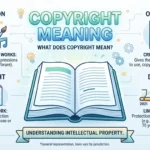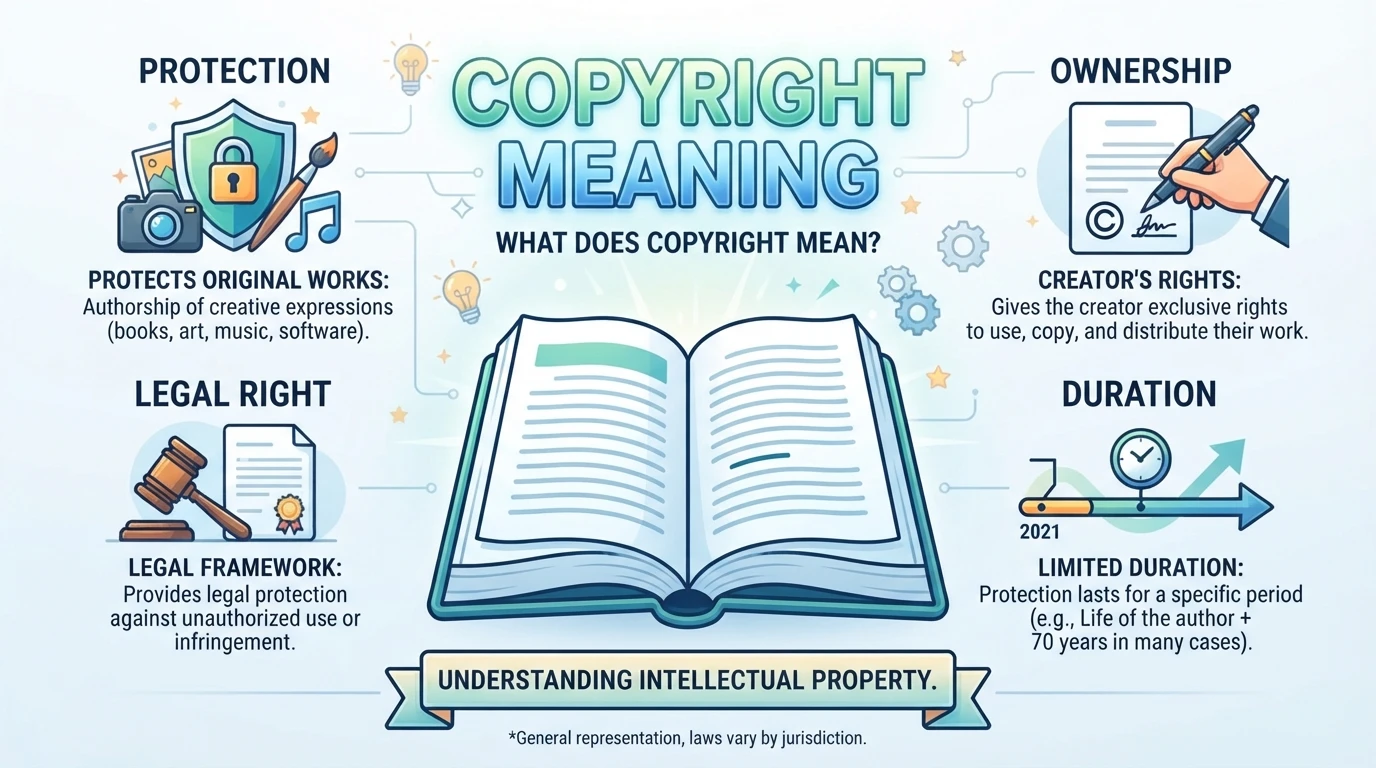
The Copyright Meaning can be confusing because the term appears everywhere, from books and music to websites, videos, photos, and other creative work. You may have seen a copyright notice without fully understanding what it protects or why it matters. Understanding the copyright meaning helps you know who owns creative content, what others can legally use, and why permission may be required. In this article, we’ll explain copyright in simple English, including its definition, purpose, examples, and common uses, so you can understand the concept clearly.
Have you ever wondered why you cannot simply copy a photo, song, video, article, or book from the internet and claim it as your own? The answer comes down to copyright. Understanding the meaning of copyright is important for students, writers, creators, businesses, and anyone who shares content online.
Copyright is a form of legal protection for original creative works. It gives creators certain rights over how their work is copied, shared, displayed, performed, or adapted. At the same time, copyright law includes important exceptions and limitations, so owning copyright does not always mean a creator can control every possible use of a work.
Whether you are writing a blog post, posting on social media, creating a YouTube video, or using someone else’s photograph, knowing the basics of copyright law can help you avoid accidental infringement and respect other people’s creative work.
What Does Copyright Mean?
Copyright is a legal right that protects an original work of authorship from certain unauthorized uses.
In simple words:
Copyright means the legal protection given to creators for their original creative work.
Copyright can apply to many types of creative expression, including:
- Books and articles
- Photographs
- Music and songs
- Films and videos
- Paintings and illustrations
- Computer software
- Architectural designs
- Dramatic works
- Certain types of digital content
For example, if a photographer takes an original photograph, the photograph may receive copyright protection. Another person generally cannot simply copy and commercially use that photograph without considering the photographer’s rights and any applicable exceptions or licenses.
Copyright Meaning in Simple English
The easiest way to understand copyright is to think of it as ownership-related protection for creative expression.
Imagine you spend several hours writing an original story. Someone else downloads it, puts their name on it, and publishes it without your permission.
Copyright law may give you legal rights concerning that copying and publication.
So, copyright helps answer an important question:
Who has the legal rights to use and control certain forms of creative work?
What Does the Word “Copyright” Mean?
The word copyright combines two concepts:
- Copy — making a reproduction or other protected use of a work.
- Right — the legal rights associated with controlling certain uses of that work.
Historically, copyright developed alongside technologies that made it easier to reproduce creative works, particularly printing.
Today, copyright is especially important because digital technology allows content to be copied and distributed around the world within seconds.
What Does Copyright Protect?
Copyright generally protects original expression, rather than ideas themselves.
This distinction is extremely important.
Copyright Can Protect
- An original novel
- A particular photograph
- A recorded song
- A movie
- An original illustration
- Original software code
- A written article
Copyright Generally Does Not Protect
- A basic idea
- A fact
- A mathematical formula by itself
- A general concept
- A word or short phrase in ordinary circumstances
For example, the idea of writing a story about two people who travel through time is not necessarily protected by copyright. However, the particular original story you write expressing that idea may be protected.
How Does Copyright Work?
Copyright generally comes into existence when an eligible original work is created and fixed in a tangible form, depending on the applicable country’s law.
This means a creator does not necessarily have to put a copyright symbol on every work for copyright protection to exist.
For example, if you write an original article and save it as a document, the work may receive copyright protection automatically under applicable law.
However, the precise rules differ between countries, and registration can provide additional legal benefits in some jurisdictions.
Who Owns Copyright?
The person who creates a work is often the initial copyright owner, but ownership can change depending on the circumstances.
Ownership may be affected by:
- Employment relationships
- Contracts
- Assignments
- Joint authorship
- Commissioned work
- Local copyright law
For example, if a graphic designer creates a logo for a company, the copyright ownership may depend on the agreement between the designer and the company and the law that applies.
This is why written contracts can be very important for creative projects.
Copyright vs. Ownership of a Physical Object
A common misunderstanding is that buying something means you automatically own its copyright.
Usually, owning a physical copy and owning copyright are two different things.
For example, suppose you buy an original painting.
You may own the physical painting, but that does not automatically mean you own every copyright interest associated with the artwork.
Similarly, purchasing a book does not normally give you the copyright in the book.
Simple Comparison
| Physical ownership | Copyright |
| Ownership of an object | Legal rights over protected creative expression |
| Example: owning a book | Example: copyright in the book’s text |
| Usually concerns the physical item | Concerns specified uses of the creative work |
What Rights Does Copyright Give a Creator?
Copyright laws vary by country, but copyright commonly gives the copyright owner certain exclusive rights.
Depending on the jurisdiction and work, these may include rights relating to:
- Reproduction — making copies.
- Distribution — distributing copies to the public.
- Public performance — performing certain works publicly.
- Public display — displaying certain works publicly.
- Adaptation — creating certain derivative or adapted works.
- Communication or making available — particularly relevant to digital content.
These rights are not unlimited. Copyright law includes exceptions, limitations, and other rules.
What Is Copyright Infringement?
Copyright infringement generally occurs when someone uses a copyrighted work in a way that violates the copyright owner’s rights and does not fall within an applicable exception, limitation, license, or other legal authorization.
Common examples can include:
- Uploading someone else’s copyrighted movie without authorization
- Reproducing an article without permission
- Using a copyrighted photograph commercially without a license
- Distributing unauthorized copies of a book
The exact legal test depends on the country and circumstances.
Copyright Example
Imagine Sarah writes an original blog post.
John copies the entire article and publishes it on his website under his own name.
John has not created the original content. If he has no permission or applicable legal exception, his use may raise a copyright infringement issue.
Now imagine that another writer quotes a short portion of Sarah’s article for the purpose of criticism or commentary.
That situation may be treated differently depending on the applicable law and circumstances.
This shows why copyright questions cannot always be answered simply with “copying is illegal.”
What Is Fair Use?
Fair use is a copyright doctrine in U.S. law that can allow certain unauthorized uses of copyrighted material in circumstances specified by law.
Potential examples include certain uses for:
- Criticism
- Commentary
- News reporting
- Teaching
- Scholarship
- Research
However, not every educational, nonprofit, or small use automatically qualifies as fair use.
U.S. courts consider factors including:
- The purpose and character of the use
- The nature of the copyrighted work
- The amount used
- The effect on the potential market
Other countries use different approaches, such as specific statutory exceptions or fair dealing.
Therefore, it is important not to treat “fair use” as a universal copyright rule.
Copyright and the Internet
The internet has made copyright more important than ever.
A photograph can be copied from a website in seconds. A video can be reposted to thousands of people. An article can be duplicated across multiple websites.
But being able to copy something technically does not mean you automatically have the legal right to do so.
Common Online Copyright Mistakes
People sometimes assume:
“If it’s on Google, I can use it.”
That is incorrect.
Search engines help you find content. They do not automatically permit you to reuse everything you find.
Similarly:
“There is no copyright symbol, so it must be free.”
That is also unreliable. Copyright protection may exist without a visible copyright notice.
Copyright vs. Trademark vs. Patent
These terms are often confused because they all relate to intellectual property.
| Type | Mainly Protects | Example |
| Copyright | Original creative expression | A song or photograph |
| Trademark | Brand identifiers | A brand name or logo |
| Patent | Certain inventions | A qualifying new technical invention |
| Trade secret | Confidential valuable information | A secret business formula |
The easiest distinction is:
Copyright protects creative expression.
Trademark protects identifiers associated with goods or services.
Patent law protects qualifying inventions.
How Long Does Copyright Last?
Copyright does not normally last forever.
The duration depends on factors such as:
- The country
- When the work was created
- When the author died
- The type of work
- Whether the work has multiple authors
- Whether special rules apply
In many countries, copyright for an individual author’s work generally lasts for the author’s lifetime plus a specified number of years.
After copyright expires, a work may enter the public domain, although public-domain rules can be complicated.
Because copyright duration varies, it is best to check the law applicable to the particular work.
What Is the Public Domain?
A work in the public domain is generally not protected by copyright, meaning copyright restrictions no longer apply to that work in the relevant jurisdiction.
Public-domain works can often be used without obtaining copyright permission.
However, there is an important distinction between:
- An old work being in the public domain
- A newer edition, translation, restoration, or adaptation containing new protected material
For example, an old novel may be in the public domain, while a modern translation of that novel may have its own copyright.
What Is a Copyright License?
A copyright license is permission from a copyright owner allowing someone to use a copyrighted work under specified conditions.
A license may specify:
- Where the work can be used
- How long it can be used
- Whether commercial use is allowed
- Whether modifications are allowed
- Whether attribution is required
For example, a photographer might license an image to a business for use on its website for a particular period.
What Are Creative Commons Licenses?
Creative Commons licenses provide standardized ways for creators to give the public permission to use their works under specified conditions.
Different Creative Commons licenses can impose different requirements.
Some may require:
- Attribution
- Noncommercial use
- No modifications
- Sharing adaptations under similar terms
Therefore, seeing a Creative Commons label does not always mean “do anything you want.” You should check the specific license.
Common Copyright Myths
Myth 1: “Anything Online Is Free to Use”
False.
Online availability does not automatically remove copyright protection.
Myth 2: “Giving Credit Makes Copying Legal”
Not necessarily.
Attribution can be required by a license or may be ethically appropriate, but simply naming the creator does not automatically give you permission to use copyrighted material.
Myth 3: “I Only Used a Small Part, So It’s Always Legal”
Not necessarily.
The legality of using a portion depends on the applicable law, the type of work, the amount used, and the circumstances.
Myth 4: “Copyright Only Applies to Books”
False.
Copyright can apply to many forms of creative expression, including photographs, music, films, software, artwork, and written content.
Myth 5: “If I Change Someone Else’s Work, I Own It”
Not automatically.
Making changes to copyrighted material can still involve the copyright owner’s rights, depending on the circumstances.
How to Avoid Copyright Problems
If you create or publish content online, a few practical habits can help.
1. Create Original Content
The safest approach is often to create your own:
- Photos
- Articles
- Illustrations
- Videos
- Audio
- Graphics
2. Check Usage Rights
Before using someone else’s work, determine whether you have permission or a suitable license.
3. Read License Conditions
If a work is licensed, follow the license carefully.
4. Keep Records
If you receive permission to use content, keep a copy of the permission or license.
5. Don’t Assume Search Results Equal Permission
Finding an image, video, or article online does not automatically give you reuse rights.
FAQs
What is the simple meaning of copyright?
Copyright is legal protection for original creative works. It gives creators certain rights over how their works are used, subject to applicable exceptions and limitations.
What is an example of copyright?
An original photograph, song, book, movie, illustration, or software program can be protected by copyright.
Does copyright mean nobody can use my work?
Not necessarily. Copyright includes exceptions and limitations, and creators can also authorize others to use their work through licenses or permissions.
Is copyright the same as trademark?
No. Copyright generally protects creative expression, while trademark law primarily protects names, symbols, logos, and other identifiers associated with goods or services.
Can I use a copyrighted image if I give credit?
Giving credit alone does not automatically make an unauthorized use legal. You should have permission, a suitable license, or another legal basis for the use.
What does “all rights reserved” mean?
It is a traditional notice indicating that the copyright owner is reserving rights rather than granting broad permission for reuse. Its precise legal significance can vary by jurisdiction.
When does copyright expire?
Copyright duration varies according to the country, type of work, date of creation, authorship, and other factors. Once applicable copyright protection expires, a work may enter the public domain.
Conclusion:
The Copyright meaning is simply the legal protection given to original creative works such as books, music, videos, images, and written content. It helps creators control how their work is used and prevents unauthorized copying. Understanding copyright can help you respect creators’ rights and use content responsibly.
Understanding the meaning of copyright is essential in today’s digital world. Copyright protects many types of original creative expression and gives creators important legal rights over certain uses of their work.
The most important points to remember are:
- Copyright protects original creative expression.
- Finding content online does not automatically mean you can reuse it.
- Copyright and physical ownership are different concepts.
- Permission, licensing, and legal exceptions can allow certain uses.
- Fair use is not a blanket permission to copy content.
- Copyright duration varies depending on the work and applicable law.
- When in doubt, check the license or obtain permission before using someone else’s work.
If you are a blogger, student, photographer, designer, business owner, or social media creator, understanding basic copyright rules can help you protect your own work while respecting the rights of other creators.