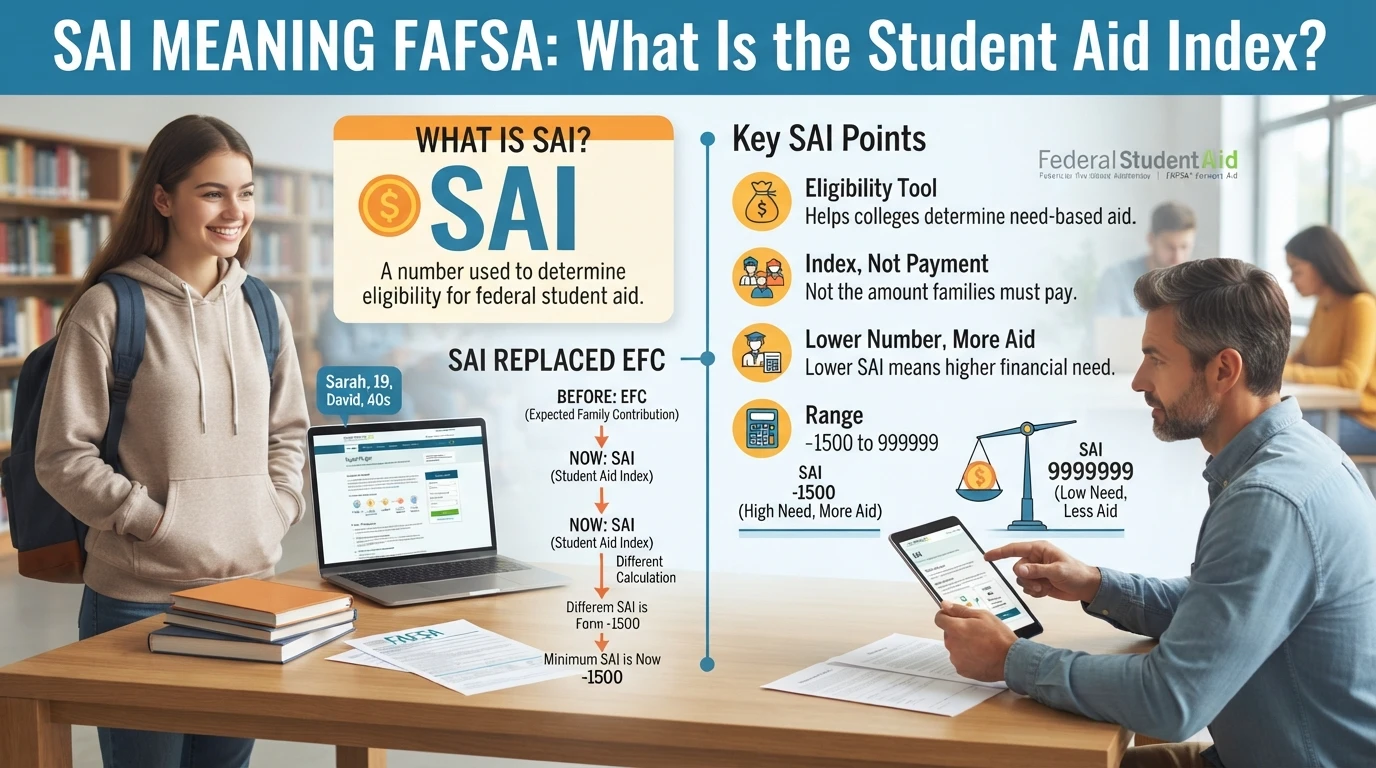
SAI Meaning FAFSA can be confusing if you’re filling out the Free Application for Federal Student Aid (FAFSA) and come across this abbreviation for the first time. SAI stands for Student Aid Index, a number used by colleges and financial aid offices to help determine a student’s eligibility for need-based financial aid. It replaced the former Expected Family Contribution (EFC) system and is not the amount your family is expected to pay. Understanding what SAI meaning FAFSA can make it easier to interpret your financial aid information and understand how your eligibility for federal, state, and college-based assistance may be assessed.
If you have recently completed the FAFSA and noticed a number labeled SAI, you may be wondering what it means and whether that number tells you how much college will cost. The answer is important: SAI, meaning FAFSA, refers to the Student Aid Index, a number used by colleges to help determine a student’s eligibility for need-based financial aid.
The SAI replaced the former Expected Family Contribution (EFC) terminology. Unlike the old name, however, the SAI is not supposed to represent the amount your family must pay for college. It is an index used to measure a student’s relative level of financial need.
Understanding your SAI can make your FAFSA Submission Summary much easier to read. In this guide, we’ll explain what SAI means on FAFSA, how it is calculated, what a high or low SAI means, how it relates to financial need, and why your SAI is not the same as your financial aid award.
What Does SAI Mean on FAFSA?
SAI stands for Student Aid Index.
It is a formula-based number calculated from information provided on the Free Application for Federal Student Aid (FAFSA). Colleges and other schools use the SAI as one factor when determining eligibility for need-based financial aid.
In simple terms:
SAI is a number that helps a school estimate how much financial need a student may have.
A lower SAI generally indicates greater financial need, while a higher SAI generally indicates lower financial need. The current SAI scale can range from -1,500 to 999,999.
Importantly, your SAI is not:
- The amount of financial aid you will receive
- The amount your family is expected to pay
- Your final college bill
- Your final financial aid offer
Your school uses your SAI along with other information, including the school’s cost of attendance and other aid, to determine your financial aid package.
Why Was the SAI Created?
The SAI replaced the Expected Family Contribution (EFC) as part of changes to the federal student aid system.
The older term “Expected Family Contribution” could be misleading because the number was not necessarily the amount a family would actually pay. The newer term Student Aid Index more clearly describes its purpose as an index used in the financial aid process.
This distinction matters because students sometimes see a number on their FAFSA and assume:
“That’s how much my family has to pay.”
That is not what the SAI means.
SAI vs. EFC: What’s the Difference?
If you’ve previously completed the FAFSA, you may remember seeing an EFC instead of an SAI.
| Feature | EFC | SAI |
| Full name | Expected Family Contribution | Student Aid Index |
| Used with | Older FAFSA system | Current FAFSA system |
| Purpose | Measure used in financial aid calculations | Index used to assess financial need |
| A dollar amount? | Not actually a bill | No |
| Can it be negative? | Generally no | Yes |
| Current range | Not applicable | -1,500 to 999,999 |
The most important practical point is that SAI is an index, not a payment requirement.
What Does a Low SAI Mean?
A low SAI generally means that the FAFSA information indicates a higher level of financial need.
For example, an SAI of:
-1,500
indicates a very high level of financial need within the SAI scale.
An SAI of:
500
would generally indicate more financial need than a much higher SAI.
Federal Student Aid explains that a lower or negative SAI indicates higher financial need and can increase a student’s likelihood of qualifying for the maximum Federal Pell Grant award.
However, you should not assume that a specific SAI automatically guarantees a specific amount of aid.
What Does a Negative SAI Mean?
A negative SAI is possible under the current system.
The SAI can go as low as -1,500.
A negative number does not mean you owe the government money.
Instead, it indicates a particularly high level of financial need under the SAI calculation.
For example:
| SAI | General Interpretation |
| -1,500 | Very high financial need |
| -500 | High financial need |
| 0 | High financial need |
| 5,000 | Lower need than a negative SAI |
| 20,000 | Generally lower financial need |
| Higher SAI | Generally lower financial need |
These are general interpretations, not guarantees of a particular financial aid award.
What Does a High SAI Mean?
A higher SAI generally indicates lower financial need according to the FAFSA calculation.
For example, a student with an SAI of 20,000 generally has a lower calculated level of need than a student with an SAI of 2,000.
But a high SAI does not automatically mean:
- You will receive no financial aid.
- Your family must pay exactly that amount.
- You cannot receive scholarships.
- You cannot receive any federal student aid.
Different types of aid have different eligibility requirements, and schools make the final decisions about the aid they offer.
How Is SAI Calculated?
Your SAI is calculated using information provided on your FAFSA.
The calculation considers financial and personal information provided by the student and, when required, FAFSA contributors.
Factors involved in the FAFSA process can include information about:
- Student finances
- Parent finances when applicable
- Income
- Assets
- Family circumstances
- Household information
- Number of family members in the household
The exact formula is established under federal law and can change over time.
This is why your SAI can change from one FAFSA year to another. Federal Student Aid notes that the SAI is calculated each year you submit a FAFSA and may change because of changes to the formula or the information provided.
SAI and Cost of Attendance
Your SAI is only one part of the financial aid calculation.
Another important number is your school’s Cost of Attendance (COA).
Cost of attendance can include expenses such as:
- Tuition
- Fees
- Housing
- Food
- Books
- Supplies
- Transportation
- Other education-related expenses
A simplified example can help.
Imagine:
Cost of attendance: $20,000
SAI: $5,000
A simplified need calculation could look like:
$20,000 − $5,000 = $15,000
This does not mean the student automatically receives $15,000 in aid. Instead, it illustrates how the SAI can be used in determining financial need.
Other financial aid and program-specific rules can affect the final amount.
Why Your SAI Is Not Your College Bill
One of the biggest misconceptions about SAI is that it tells you how much you will pay.
It doesn’t.
Suppose your FAFSA shows:
SAI: 8,000
This does not mean:
“Your family will pay $8,000.”
Your school sends the financial aid offer that explains the actual types and amounts of aid available to you. Federal Student Aid specifically distinguishes the FAFSA Submission Summary from the school’s financial aid offer.
SAI and Federal Pell Grants
Your SAI can play an important role in determining eligibility for a Federal Pell Grant.
A lower SAI generally indicates greater financial need. Students with lower or negative SAIs may have a greater likelihood of qualifying for a higher Pell Grant amount, depending on applicable eligibility rules.
However, the SAI alone does not tell you exactly how much Pell Grant funding you will receive.
Your FAFSA Submission Summary may show estimated Pell Grant eligibility, but your school’s eventual aid offer provides the actual aid information after admission and the school’s financial aid process.
SAI and Other Financial Aid
Your SAI may also be used as part of determining eligibility for other forms of need-based assistance.
Depending on the program and school, financial aid may include:
- Federal grants
- Federal Work-Study
- Federal student loans
- State financial aid
- Institutional grants
- Scholarships
- Other assistance
FAFSA information can be used by federal programs, states, schools, and some other aid providers to determine eligibility.
Where Can You Find Your SAI?
After your FAFSA is processed, you can find your official SAI on your FAFSA Submission Summary.
Federal Student Aid says you can access the summary through your StudentAid.gov account.
A general process is:
- Log in to your StudentAid.gov account.
- Open your processed FAFSA submission.
- Select View FAFSA Submission Summary.
- Open the Eligibility Overview section.
- Look for your Student Aid Index.
Your FAFSA confirmation page may show an estimated SAI, while your processed FAFSA Submission Summary contains the official SAI.
What Should You Do After Seeing Your SAI?
Don’t panic if the number is higher or lower than you expected.
Instead, take a few practical steps.
1. Review Your FAFSA Information
Check the information on your FAFSA Submission Summary carefully.
Look for errors involving:
- Income
- Household information
- Personal information
- Assets
- Contributor information
If something is incorrect, you may be able to correct.
2. Check Your School’s Financial Aid Offer
Your SAI is not your final financial aid package.
Once you’ve been admitted, review the actual aid offers from your schools.
Compare:
- Grants
- Scholarships
- Work-study
- Loans
- Net cost
- Total attendance expenses
3. Compare Your Actual Costs
A school with a higher sticker price may sometimes offer more financial aid than a less expensive school.
Focus on the net price, not just the published cost.
4. Ask the Financial Aid Office Questions
If your financial circumstances have changed or something on your FAFSA does not accurately reflect your situation, contact your school’s financial aid office.
What If Your SAI Seems Wrong?
If your SAI seems unexpectedly high or low, first review your FAFSA information.
A mistake on the application can affect the calculation.
For example, you might discover that:
- A financial figure was entered incorrectly.
- A contributor’s information is incomplete.
- Household information needs correction.
- Your circumstances have changed.
Federal Student Aid recommends reviewing the FAFSA Submission Summary and correcting inaccurate information when necessary.
Common SAI Misconceptions
Myth 1: SAI Is the Amount You Must Pay
False.
The SAI is not a bill or a required family payment amount.
Myth 2: A Negative SAI Means You Owe Money
False.
A negative SAI indicates a higher level of financial need.
Myth 3: A High SAI Means You Cannot Get Any Aid
Not necessarily.
Eligibility depends on the specific type of aid, school, program, and other factors.
Myth 4: Your SAI Never Changes
False.
The SAI is recalculated each year you submit the FAFSA, and it can change because of your information and changes to the applicable formula.
Myth 5: SAI and Financial Aid Offer Are the Same
False.
Your school creates the financial aid offer after considering your FAFSA information and other factors.
SAI vs. Financial Need vs. Financial Aid
These three terms are easy to confuse.
| Term | What It Means |
| SAI | An index used to help assess financial need |
| Financial need | The amount of assistance a student may need based on costs and available resources |
| Financial aid | Actual grants, scholarships, work-study, loans, or other assistance offered |
Understanding this difference can make the FAFSA process much less confusing.
FAQs
What does SAI mean on FAFSA?
SAI stands for Student Aid Index. It is a number calculated from FAFSA information and used by schools to help determine a student’s eligibility for need-based financial aid.
Is a lower SAI better?
For purposes of demonstrating financial need, generally yes. A lower SAI indicates a higher level of financial need. A negative SAI indicates particularly high financial need.
What is the lowest possible SAI?
The current SAI scale ranges from -1,500 to 999,999.
Does SAI tell me how much financial aid I will receive?
No. Your SAI is not a financial aid award. Your school uses your SAI and other information to determine the aid it offers you.
Is SAI the same as EFC?
No. SAI replaced EFC as the terminology used in the federal student aid system. The SAI is an index rather than an amount your family is expected to contribute.
Where can I find my SAI?
You can find your official SAI in your FAFSA Submission Summary after your FAFSA has been processed through your StudentAid.gov account.
Can my SAI change every year?
Yes. Your SAI is calculated each year you submit a FAFSA and may change based on your FAFSA information and changes to the applicable formula.
Conclusion:
Understanding what the SAI meaning FAFSA can make the financial aid process much easier to navigate. The Student Aid Index helps colleges and financial aid offices assess a student’s financial need. Remember that the SAI is not a bill or the exact amount your family must pay. Instead, it is an important factor used when determining eligibility for need-based financial aid. Knowing what your SAI represents can help you better understand your FAFSA results and make informed decisions about college costs and financial assistance.
Understanding what SAI meaning FAFSA is important because the Student Aid Index is one of the key numbers you’ll see after completing the FAFSA. The SAI is a formula-based index used to help schools determine a student’s level of financial need.
The most important thing to remember is that your SAI is not the amount your family must pay, and it is not the amount of financial aid you will receive. A lower or negative SAI generally indicates greater financial need, while a higher SAI generally indicates lower financial need.
When you receive your SAI, don’t judge your college affordability from that number alone. Review your FAFSA Submission Summary, check for errors, compare your schools’ actual financial aid offers, and look at the total cost of attendance.