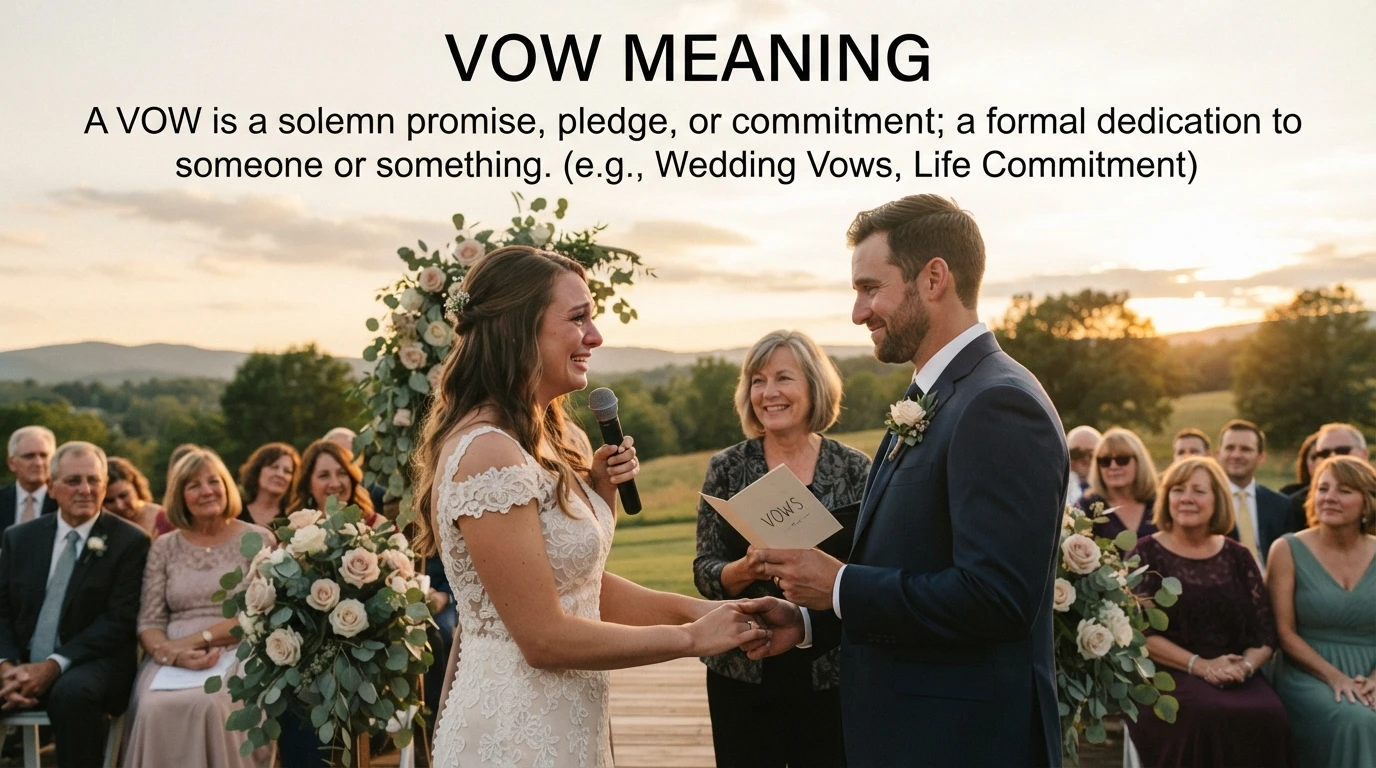
Vow Meaning can be confusing because the word “vow” has more than one use, depending on the context. You may see it when someone makes a serious promise, especially in relationships, marriage, or important personal commitments. Understanding the vow meaning helps you recognize what someone means when they say they have made or broken a vow. In this article, we will explain the meaning of “vow” in simple English, along with its definitions, examples, synonyms, and common uses in everyday conversation.
The word “vow” can appear in weddings, relationships, religious ceremonies, literature, and everyday conversations. But what exactly does it mean? If you are searching for the vow meaning, the word generally refers to a serious promise or commitment that a person makes.
For example, when someone says, “I vow to always support you,” they are making a strong promise. The word can describe both the promise itself and the act of making that promise.
What Does Vow Mean?
A vow is a solemn or serious promise to do something or to behave in a particular way.
As a noun, “vow” means a serious promise:
She made a vow to help her community.
As a verb, “vow” means to make a serious promise:
He vowed to never give up.
The word often suggests that the promise is important, sincere, and intended to be kept.
Simple Definition of Vow
Vow = a serious promise or commitment.
Some common synonyms include:
- Promise
- Pledge
- Commitment
- Oath
- Swear
- Guarantee
- Assurance
However, these words are not always interchangeable. A vow often carries a stronger emotional, moral, religious, or ceremonial meaning than an ordinary promise.
Vow Meaning in Simple English
In simple English, a vow means:
A very serious promise that someone makes to do or not do something.
For example:
- “I vow to be honest with you.”
- “She vowed to protect her family.”
- “They exchanged wedding vows.”
- “He vowed never to return.”
These sentences all describe strong commitments.
Vow as a Noun
When “vow” is used as a noun, it refers to the promise itself.
Examples
- His vow was difficult to keep.
- She made a vow to her parents.
- Their wedding vows were emotional.
- He broke his vow.
- She remained faithful to her vow.
In these examples, “vow” is something a person makes, keeps, or breaks.
Vow as a Verb
“Vow” can also function as a verb. In this form, it means to make a serious promise.
Examples
- He vowed to change his behavior.
- She vowed to finish the project.
- They vowed to support one another.
- The politician vowed to improve education.
- He vowed never to lie again.
A common structure is:
vow + to + verb
For example:
She vowed to work harder.
Another common structure is:
vow + never to + verb
For example:
He vowed never to return.
Vow Meaning in a Wedding
One of the most familiar uses of vow is in marriage.
Wedding vows are promises that two people make to each other during a wedding ceremony.
These promises can involve:
- Love
- Loyalty
- Respect
- Support
- Trust
- Commitment
- Partnership
Traditional wedding vows may contain promises to remain together through difficult and happy times.
Modern couples may also write their own vows.
Example of a Wedding Vow
“I promise to support you, respect you, and stand beside you through life’s challenges.”
This is a vow because it expresses a serious commitment.
Vow vs. Promise
The words vow and promise are closely related, but there is a difference in strength and tone.
| Vow | Promise |
| Usually very serious | Can be serious or casual |
| Often emotional or formal | Common in everyday speech |
| Can have religious or ceremonial meaning | Usually personal or practical |
| Often implies strong commitment | Can refer to a simple agreement |
| Common in weddings | Common in everyday situations |
For example:
“I promise to call you tonight.”
This is an ordinary promise.
But:
“I vow to stand by you for the rest of my life.”
This sounds much more serious and emotional.
Vow vs. Oath
Vow and oath can both refer to serious promises, but they are used differently.
An oath often has a formal, legal, public, or religious context.
For example:
“The witness took an oath to tell the truth.”
A vow is often more personal or ceremonial.
For example:
“They exchanged vows at their wedding.”
Quick Difference
Vow: A serious personal or ceremonial promise.
Oath: A solemn promise, often made formally or under authority.
Vow vs. Pledge
A pledge is also a strong promise or commitment.
For example:
“The students pledged to respect the rules.”
A vow can sound more solemn or emotional:
“She vowed to remain loyal to her family.”
The exact meaning depends on context.
Religious Meaning of Vow
The word vow can also have a religious meaning.
In some religious traditions, a vow is a solemn promise made to God or as part of religious life.
For example, a person may make a vow involving:
- Religious service
- Devotion
- Charity
- Simplicity
- Commitment to a spiritual path
In this context, breaking a vow may be viewed as a serious moral or religious matter.
Historical Background of the Word “Vow”
The word vow has a long history in English.
It comes from Old French and ultimately from Latin votum, meaning a solemn promise, vow, or wish offered to a deity.
Over time, the word developed broader meanings in English. Today, it can refer to religious commitments, marriage promises, personal commitments, and strong declarations.
This historical background helps explain why “vow” often sounds more solemn than the everyday word “promise.”
Common Phrases With Vow
Several expressions commonly use the word “vow.”
Make a Vow
To make a vow means to make a serious promise.
She made a vow to help others.
Take a Vow
To take a vow means to formally commit yourself to something.
He took a vow of silence.
Keep a Vow
To keep a vow means to honor the promise.
She kept her vow despite many difficulties.
Break a Vow
To break a vow means to fail to honor it.
He broke his vow and returned to his old habits.
Exchange Vows
This expression is especially common in weddings.
The couple exchanged vows in front of their families.
Vow to Do Something
This means to strongly promise to do something.
The company vowed to improve its customer service.
What Is a Vow of Silence?
A vow of silence is a serious commitment not to speak for a specific period or, in some religious contexts, as part of a way of life.
For example:
The monk took a vow of silence.
The phrase is also sometimes used figuratively.
The employees took a vow of silence about the surprise.
Here, it simply means that they agreed not to reveal information.
What Is a Vow of Poverty?
A vow of poverty is a religious commitment to live without personal wealth or possessions in certain religious traditions.
The exact practices vary between religious communities.
The phrase can also be used humorously in everyday language:
After paying all his bills, he joked that he was living under a vow of poverty.
In this example, the phrase is not being used literally as a religious vow.
Vow in Literature
Writers frequently use the word vow because it creates a sense of seriousness, emotion, and commitment.
A character might:
- Vow revenge
- Vow loyalty
- Vow to protect someone
- Vow never to return
- Vow to uncover the truth
For example:
“She vowed to uncover the truth.”
This sentence sounds stronger than:
“She promised to find the truth.”
The word “vowed” suggests determination and emotional intensity.
Vow in Everyday Conversation
Although “vow” can sound formal, it is also used in everyday speech.
People may say:
“I vow I’ll never do that again.”
This can be serious or slightly dramatic depending on the situation.
For example, after eating extremely spicy food, someone might jokingly say:
“I vow never to eat that much spicy food again!”
The meaning remains a strong promise, but the context makes it humorous.
Common Misunderstandings About Vow
Myth 1: A Vow Is Always Religious
Not necessarily.
Vows can be religious, but people also make personal, romantic, social, and professional vows.
Myth 2: Vow and Promise Are Completely Different
They are closely related.
The main difference is usually tone and seriousness. A vow often sounds more solemn or significant than an ordinary promise.
Myth 3: Vows Are Only Used at Weddings
Wedding vows are one of the most familiar examples, but vows can be made in many other situations.
Myth 4: “Vow” Is Only a Noun
No.
“Vow” can be both a noun and a verb.
- Noun: “He made a vow.”
- Verb: “He vowed to change.”
How to Use “Vow” Correctly
If you want to use “vow” naturally, remember these common patterns.
As a Noun
make a vow
She made a vow to her family.
keep a vow
He kept his vow.
break a vow
She broke her vow.
take a vow
He took a vow of silence.
As a Verb
vow to + verb
They vowed to remain together.
vow never to + verb
He vowed never to repeat the mistake.
vow that + sentence
She vowed that she would return.
Vow Synonyms
Depending on the context, you can replace “vow” with several related words.
| Word | Meaning/Tone |
| Promise | General commitment |
| Pledge | Serious commitment |
| Oath | Formal or solemn promise |
| Commitment | Strong dedication |
| Assurance | Statement intended to give confidence |
| Swear | Strongly promise or declare |
| Guarantee | Promise that something will happen |
The best synonym depends on the sentence.
FAQs
What does vow mean in simple words?
A vow means a solemn promise to do something or remain committed to someone or something.
Is a vow the same as a promise?
A vow is a type of promise, but it usually sounds more serious, formal, emotional, or solemn than an ordinary promise.
What does vow mean in marriage?
A wedding vow is a serious promise that one partner makes to another during a marriage ceremony. It often expresses love, loyalty, support, and commitment.
Is vow a noun or a verb?
It can be both. As a noun, it means a serious promise. As a verb, it means to make a serious promise.
What does “I vow” mean?
“I vow” means “I strongly promise” or “I solemnly promise.”
What does “break a vow” mean?
To break a vow means to fail to keep or honor a serious promise.
What is the difference between a vow and an oath?
Both are solemn promises. An oath is often associated with formal, legal, or religious situations, while a vow is frequently personal, romantic, or ceremonial.
Conclusion:
The vow meaning is centered on the idea of a serious promise or commitment. The word can function as both a noun and a verb and is commonly used in weddings, religion, literature, relationships, and everyday conversation.
A vow is generally stronger in tone than an ordinary promise. You can make a vow, keep a vow, break a vow, take a vow, or vow to do something.
The easiest way to remember it is:
Vow = a serious promise that someone intends to honor.
Whether it appears in wedding vows, a vow of silence, a personal commitment, or a dramatic statement in a story, the word always conveys determination and seriousness.