Pallet meaning can be confusing because the word has several uses in English, depending on the context. A pallet may refer to a flat platform used for storing and transporting goods, while “pallet” can also have older or less common meanings related to art, bedding, or other objects. It is also easy to confuse pallet with similar words such as “palette” and “palate.” In this article, you’ll learn the pallet meaning, its different uses, common examples, and the key differences between pallet, palette, and palate.
Pallets are essential in shipping, logistics, warehousing, manufacturing, and supply chains because they make handling large quantities of products faster and more efficient.
In this guide, we’ll explain the pallet meaning, its history, common types, practical uses, examples, and the important difference between pallet, palette, and palate.
What Does “Pallet” Mean?
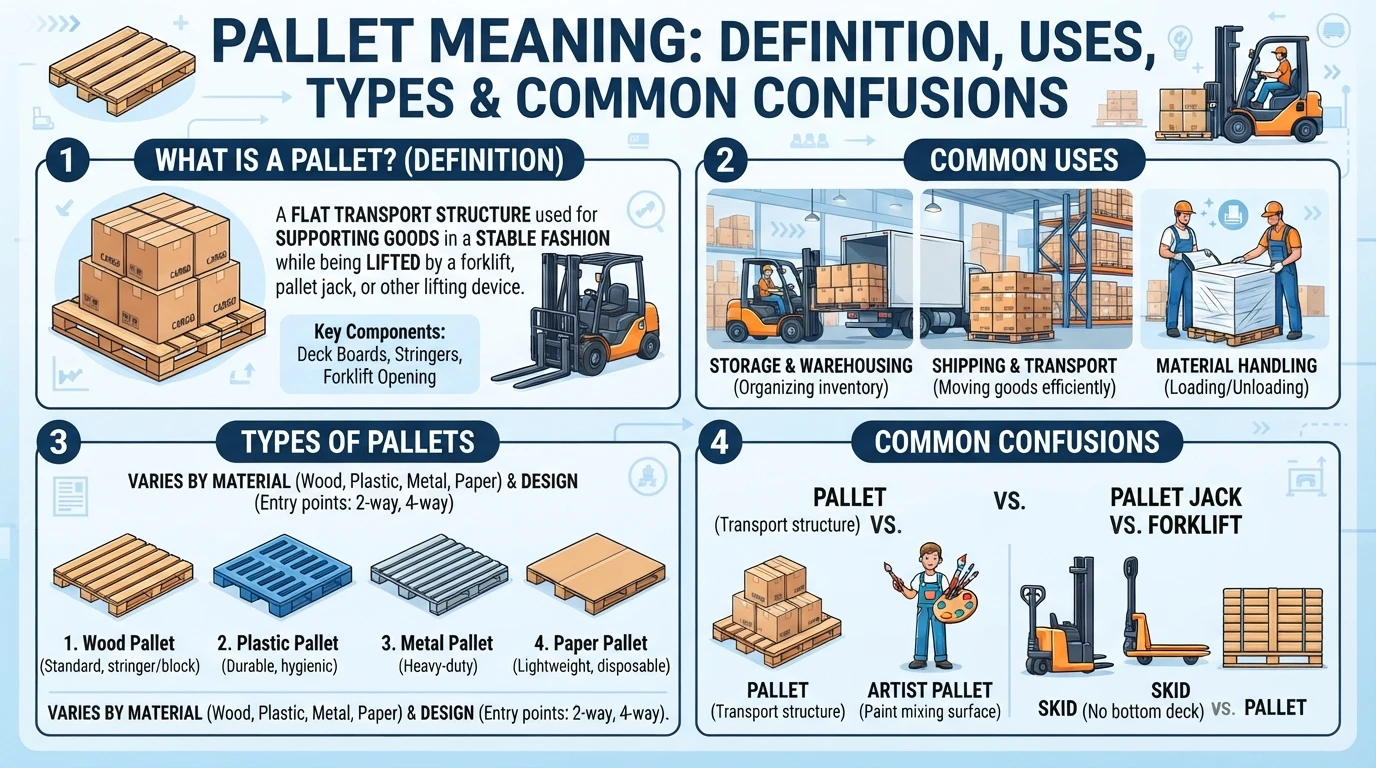
The most common meaning of pallet is a flat platform designed to hold goods so they can be moved or stored efficiently.
A pallet is commonly made from:
- Wood
- Plastic
- Metal
- Pressed or composite materials
For example:
“The warehouse worker loaded the boxes onto a pallet.”
Pallet Meaning in Simple English
In simple terms:
A pallet is a flat platform used to carry and move goods.
Instead of moving dozens of individual boxes separately, workers can place them on one pallet and move the entire load together.
What Is a Pallet Used For?
Common uses include:
- Storing products in warehouses
- Transporting goods by truck, train, ship, or airplane
- Loading and unloading shipments
- Organizing inventory
- Protecting goods from direct contact with the floor
- Making forklift handling easier
For example, a grocery distributor might place hundreds of cans or packaged foods on pallets. A forklift can then move an entire pallet rather than requiring workers to carry each box individually.
How Does a Pallet Work?
A pallet is designed to create space underneath a load.
That space allows the forks of a forklift or pallet jack to slide underneath it.
A basic process looks like this:
- Someone places the products on the pallet.
- Someone may stack and secure the products.
- A forklift or pallet jack slides underneath.
- Someone lifts the pallet.
- Someone moves the entire load to another location.
- Someone can then store the goods, load them onto a vehicle, or unload them.
This simple design has made pallets extremely important to modern logistics.
Types of Pallets
Pallets come in different materials, sizes, and designs.
1. Wooden Pallets
Wooden pallets are among the most common types.
They are popular because they are:
- Relatively inexpensive
- Strong
- Easy to repair
- Widely available
- Suitable for many shipping applications
2. Plastic Pallets
Plastic pallets are often used where cleanliness, durability, or moisture resistance is important.
Advantages can include:
- Resistance to moisture
- Easy cleaning
- Consistent dimensions
- Reusability
- Resistance to some pests
3. Metal Pallets
Metal pallets are designed for demanding environments.
They may be made from materials such as steel or aluminum.
They are useful when:
- Someone must transport the heavy loads.
- High durability is required
- Harsh conditions will expose the pallet.
- Long-term reuse is important
Metal pallets are generally more expensive than basic wooden pallets.
4. Pressed Wood Pallets
Pressed wood pallets are made from compressed wood fibers or wood materials.
They can be lightweight and useful for certain shipping applications.
Their design may also make them easier to stack or dispose of after use, depending on the specific product.
Standard Pallet Sizes
Pallet dimensions vary by country, industry, and shipping system.
Some common dimensions include:
| Pallet Type | Common Dimensions |
| Standard North American pallet | 48 × 40 inches |
| Euro pallet | 1200 × 800 mm |
| Industrial pallet | Various sizes |
| Custom pallet | Designed for a specific product |
Not every pallet has the same dimensions. Businesses choose pallet sizes based on their products, storage systems, transportation requirements, and handling equipment.
Pallet vs. Palette vs. Palate
One of the biggest problems with the word pallet is that it sounds exactly like other English words.
The three commonly confused words are:
- Pallet
- Palette
- Palate
Although they sound similar, their meanings are completely different.
| Word | Meaning | Example |
| Pallet | Platform for transporting goods | “The boxes are on a pallet.” |
| Palette | Board or range of colors | “The artist chose a bright palette.” |
| Palate | The roof of the mouth; also sense of taste | “The dish pleased her palate.” |
Pallet
“The warehouse received ten pallets of products.”
Think shipping and storage.
Palette
“The designer used a soft color palette.”
Think art and colors.
Palate
“The spicy food was too strong for his palate.”
Think taste and the mouth.
A simple memory trick is:
Pallet = products
Palette = painting
Palate = taste
Pallet Meaning in Shipping
In the shipping industry, pallets are extremely important.
A pallet groups them into one manageable unit.
For example, imagine a company shipping 500 boxes.
Without pallets, workers might need to move hundreds of individual boxes.
With pallets, they can organize the boxes into several large loads and move them using forklifts or pallet jacks.
This saves time and reduces unnecessary manual handling.
Pallet Meaning in Warehousing
Warehouses use pallets to organize inventory.
Pallets can be stored:
- On warehouse floors
- In pallet racks
- In distribution centers
- Near loading docks
- In refrigerated storage areas
A warehouse may assign a particular location to each pallet so workers can quickly identify and retrieve inventory.
This makes inventory management more organized.
Pallet Jack vs. Forklift
A pallet jack and a forklift can both move pallets, but they are not the same.
Pallet Jack
A pallet jack is generally designed to move pallets short distances, especially across warehouse floors.
Forklift
A forklift can lift pallets much higher and is commonly used to place loads onto storage racks or move heavier loads.
| Feature | Pallet Jack | Forklift |
| Basic purpose | Move pallets | Lift and move pallets |
| Lifting height | Usually limited | Much greater |
| Typical use | Warehouse floors | Warehouses, loading areas |
| Design | Simpler | More complex |
Why Are Pallets Important?
Pallets may look simple, but they play a major role in global commerce.
They help businesses:
- Move products quickly
- Reduce handling time
- Organize inventory
- Improve warehouse efficiency
- Protect goods
- Use forklifts and pallet jacks effectively
- Standardize shipping processes
Without systems such as palletization, transporting large quantities of products would be much more difficult.
What Is Palletization?
Palletization means arranging goods on pallets so they can be handled and transported efficiently.
For example, a company might stack cartons in a particular pattern on a pallet and then secure them with stretch wrap.
Good palletization can help:
- Prevent products from falling
- Use warehouse space efficiently
- Make loads stable
- Simplify transportation
- Reduce product damage
How does someone secure goods on a pallet?
People may secure products using several methods.
Stretch Wrap
Someone can wrap stretch film around boxes to keep them together.
Strapping
Plastic or metal straps can hold heavy loads in place.
Corner Protectors
These can help protect boxes and improve load stability.
Pallet Covers
Covers may protect products from dust, moisture, or other environmental factors.
The best method depends on the type of product and shipping conditions.
A Simple Real-World Example
Imagine a supermarket ordering 200 boxes of bottled drinks.
Instead of transporting each box separately, the supplier can:
- Place the boxes on several pallets.
- Stack them securely.
- Wrap the loads.
- Move them with a forklift.
- Load them onto a delivery truck.
- Deliver them to the supermarket.
- Unload them using warehouse equipment.
The pallet acts as the foundation for the entire load.
Are Wooden Pallets Reusable?
Yes, people can reuse many wooden pallets.
If a pallet remains structurally sound, businesses may use it multiple times.
However, damaged pallets should be inspected and repaired or removed from service when necessary.
Reusing pallets can help reduce waste and make shipping operations more efficient.
Are Pallets Recyclable?
People can recycle or repurpose some pallets.
Wooden pallets may be:
- Repaired
- Reused
- Dismantled
- Converted into wood products
- Recycled
Plastic pallets may also be recyclable depending on the material and local recycling systems.
Businesses should follow applicable waste-management rules rather than assuming every pallet can go into ordinary recycling.
Common Misconceptions About Pallets
Myth 1: Every Pallet Is Wooden
Not true.
Wood is common, but pallets can also be made from plastic, metal, pressed wood, and composite materials.
Myth 2: People use pallets only for shipping.
Not necessarily.
They are also widely used for warehouse storage, inventory organization, and manufacturing operations.
Myth 3: All Pallets Have the Same Size
No.
Pallet dimensions vary depending on region, industry, transportation requirements, and product type.
Myth 4: Pallet and Palette Mean the Same Thing
They do not.
A pallet carries products, while a palette is associated with colors or artistic materials.
Pallet Meaning in Everyday Conversation
Although “pallet” is most strongly associated with logistics, people may encounter the word in ordinary situations.
For example:
“There was a pallet of bottled water outside the store.”
Here, the speaker means a large quantity of goods arranged on a transport platform.
Another example:
“The delivery arrived on two pallets.”
FAQs
What is the difference between pallet and palette?
A pallet is a platform used to carry goods. A palette is a range or board of colors, especially in art and design.
What is the difference between pallet and palate?
A pallet carries goods, while a palate refers to the roof of the mouth and can also describe someone’s sense of taste.
Are pallets reusable?
Yes. Many pallets can be reused if they remain safe and structurally sound.
What is palletization?
Palletization is the process of arranging products on a pallet to make them easier and safer to store, handle, and transport.
Conclusion:
The pallet meaning depends on the context, but it most commonly refers to a flat platform used to store, move, and transport goods. The word can also have less common meanings, so context is important when identifying its intended use. It is also easy to confuse “pallet” with “palette” and “palate,” but each word has a different meaning. Understanding these differences can help you use pallet correctly in writing and everyday conversations.
The pallet meaning is simple: a pallet is a flat platform used to support, store, and transport goods. Pallets are a basic but essential part of modern warehouses, shipping systems, manufacturing, and supply chains.
It’s also important not to confuse pallet, palette, and palate. Remember:
- Pallet = platform for goods
- Palette = colors or artistic materials
- Palate = mouth and sense of taste
Once you understand this distinction, you’ll be able to recognize exactly what pallet means whenever you encounter it in shipping, business, warehousing, or everyday conversation.