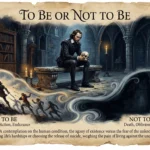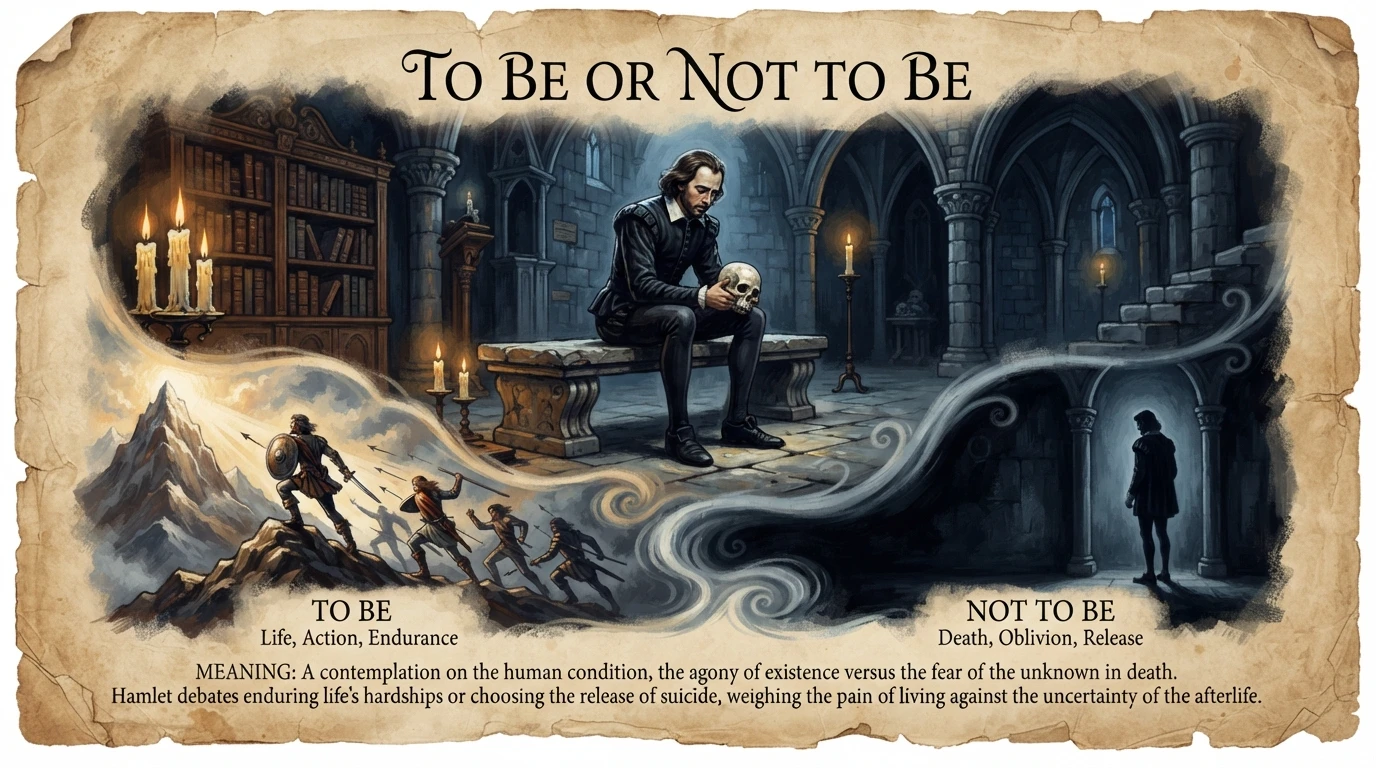
To be or not to be, meaning, is a phrase that has become one of the most famous lines in English literature. Spoken by Prince Hamlet in William Shakespeare’s Hamlet, it raises a deep question about existence, suffering, choices, and whether life should be endured despite its difficulties. Although the wording may sound simple, the idea behind it is much more complex. Understanding what ” to be or not to be ” means helps readers see why this line has remained important for centuries. In this article, you’ll explore its meaning, context, significance, and how the phrase is used in modern English.
Few phrases in English are as famous as “to be or not to be.” Even people who have never read Shakespeare may recognize these words. The phrase comes from William Shakespeare’s Hamlet and has become a powerful expression of existence, choice, suffering, and uncertainty.
But what does to be or not to be meaning actually involve? Is it simply asking whether someone should live or die? While that is part of the passage, the famous line raises a much broader philosophical question about whether it is better to continue facing life’s difficulties or escape from them.
In this guide, we’ll explain the to be or not to be meaning in simple English, explore its Shakespearean context, examine the famous soliloquy, discuss its philosophical ideas, and look at how the phrase is used in modern English.
What Does “To Be or Not to Be” Mean?
The phrase “to be or not to be” literally means:
“To exist or not to exist.”
In Hamlet, Shakespeare uses the phrase to introduce a deep question about whether it is better to continue living despite suffering or to end one’s existence and escape life’s troubles.
The phrase can therefore be understood as:
- To live or not to live
- To exist or not to exist
- To continue or give up
- To face difficulties or escape them
- To endure suffering or seek an end to suffering
However, the passage is more complicated than simply asking whether someone should live or die.
Where Does “To Be or Not to Be” Come From?
“To be or not to be” comes from Shakespeare’s tragedy Hamlet, Prince of Denmark.
The line appears in Act 3, Scene 1, during one of the most famous soliloquies in English literature.
Hamlet is struggling with grief, uncertainty, betrayal, and the difficult circumstances surrounding his father’s death. During the soliloquy, he considers the nature of suffering and whether people should continue enduring life’s hardships.
The opening line introduces this internal debate.
Who Says “To Be or Not to Be”?
The phrase is spoken by Hamlet, the main character of Shakespeare’s play.
Hamlet is the Prince of Denmark. After his father’s death, he learns that his father may have been murdered by Hamlet’s uncle, Claudius, who has taken the throne and married Hamlet’s mother.
Hamlet becomes consumed by questions about:
- Death
- Revenge
- Morality
- Justice
- Existence
- Uncertainty
- Human suffering
These concerns help explain why the famous soliloquy is so philosophical.
The Context of the Famous Soliloquy
To understand the meaning to be or not to be, it helps to understand Hamlet’s situation.
He is facing a painful world filled with uncertainty.
His father is dead, his mother has quickly remarried, and the ghost of his father has told him that Claudius is responsible for his death.
Hamlet must decide what to do.
Should he seek revenge?
Should he remain passive?
Can he trust what he has been told?
What happens after death?
These questions contribute to his emotional and philosophical struggle.
What Does “To Be” Mean?
In the phrase, “to be” means to exist or continue living.
Hamlet is considering the difficulties involved in continuing to live.
Life contains:
- Pain
- Injustice
- Betrayal
- Disappointment
- Loss
- Fear
- Uncertainty
The question is whether enduring these difficulties is preferable to escaping them.
What Does “Not to Be” Mean?
“Not to be” refers to the possibility of no longer existing.
In the context of the soliloquy, this points toward death.
Hamlet wonders whether death might provide an escape from life’s suffering. However, he is also uncertain about what comes after death.
This uncertainty becomes one of the central ideas of the speech.
Why Is the Phrase So Powerful?
The phrase is powerful because it expresses a universal human question in only six words.
Almost everyone experiences moments when they wonder:
- Should I continue?
- Should I change direction?
- Is this struggle worth it?
- What happens if I choose another path?
- Is the unknown better than the situation I know?
Shakespeare turns these questions into a memorable philosophical statement.
“To Be or Not to Be” in Simple English
If Shakespeare’s language feels difficult, the basic idea can be simplified:
“Should I continue living and facing life’s problems, or would it be better to escape from them?”
Hamlet does not immediately answer the question.
Instead, he thinks through the possible consequences.
The Role of Death in the Speech
Death is a major theme in the soliloquy.
Hamlet considers death as a possible escape from suffering. But there is a problem: nobody knows exactly what happens after death.
This uncertainty makes the decision difficult.
The idea can be summarized as:
Life is painful, but death is unknown.
People may tolerate suffering because they fear what they cannot understand.
Why Does Hamlet Hesitate?
Hamlet’s hesitation is connected to uncertainty.
If death were simply like falling asleep, the decision might seem easier. But Hamlet wonders whether death could bring something unexpected.
The unknown after death creates fear.
This is one of Shakespeare’s key observations about human behavior: fear of uncertainty can prevent people from making difficult choices.
The Philosophical Meaning
The phrase has become famous partly because it explores philosophical questions about existence.
1. Existence
What does it mean to exist?
2. Suffering
Why do people continue living despite pain?
3. Death
What happens when life ends?
4. Choice
How should people respond to difficult circumstances?
5. Uncertainty
How does the unknown affect our decisions?
These questions remain relevant centuries after Shakespeare wrote the play.
“To Be or Not to Be” as a Metaphor
Today, people sometimes use the phrase metaphorically.
For example:
“To work or not to work—that is the question.”
This humorous variation borrows Shakespeare’s structure to describe an ordinary decision.
Someone might also say:
“To travel or not to travel?”
Here, the phrase does not necessarily have anything to do with death. It simply means “Should I do this or should I not?”
Modern Examples
Example 1: Career Decision
“To stay or not to stay—that is my question.”
Someone might use the phrase when deciding whether to remain in a job.
Example 2: Relationship
“To call or not to call?”
This can describe uncertainty about contacting someone.
Example 3: Everyday Humor
“To study or not to study—that is the question.”
This can jokingly describe a student’s decision before an exam.
Common Misunderstandings
Myth 1: The Phrase Only Means “Live or Die”
This is the most common interpretation, but the speech explores much more.
It also examines:
- Suffering
- Fear
- Uncertainty
- Decision-making
- Human nature
Myth 2: Hamlet Immediately Wants to Die
Not exactly.
Hamlet is contemplating the possibility of death, but the speech is primarily a reflection on the difficult question of existence and suffering.
Myth 3: The Phrase Is a Modern Expression
No.
It was written by Shakespeare in the early 17th century.
Myth 4: “To Be” Only Means Happiness
No.
“To be” refers more broadly to existence or continuing to live, regardless of whether life is pleasant.
Why Is “To Be or Not to Be” Still Relevant?
Although Shakespeare wrote Hamlet centuries ago, people still face decisions involving uncertainty, suffering, responsibility, and change.
The phrase has therefore become part of everyday English.
It can describe serious philosophical questions as well as lighthearted choices.
That flexibility is one reason the phrase remains so recognizable.
How to Use “To Be or Not to Be” Correctly
You can use the phrase when discussing an important choice.
Formal or Literary Use
“The character’s dilemma reflects Hamlet’s famous question of whether to continue enduring suffering.”
Humorous Use
“To order pizza or cook dinner—that is the question.”
Figurative Use
“To remain in the old job or start something new became his own ‘to be or not to be’ moment.”
The phrase works best when the choice involves some degree of uncertainty or importance.
Related Shakespearean Terms
If you’re studying Hamlet, several related concepts are useful:
| Term | Meaning |
| Soliloquy | A speech expressing a character’s private thoughts |
| Existentialism | A philosophical focus on existence and individual choice |
| Tragedy | A dramatic work involving serious conflict and often suffering |
| Monologue | A long speech by one character |
| Revenge | The desire to punish someone for wrongdoing |
| Mortality | The condition of being subject to death |
Why Is the Speech Called a Soliloquy?
A soliloquy is a dramatic speech in which a character expresses thoughts aloud, usually while alone or believing they are alone.
Hamlet’s “to be or not to be” speech allows the audience to hear his private thoughts.
This makes the audience feel close to his internal conflict.
FAQs
What is the simple meaning of “to be or not to be”?
It means “to exist or not to exist,” and in Hamlet, it refers to the question of whether it is better to continue living despite suffering or escape through death.
Who said, “to be or not to be”?
Hamlet says the phrase in Shakespeare’s Hamlet, Act 3, Scene 1.
What does “to be” mean in Hamlet?
“To be” means to exist or continue living while facing the difficulties of life.
What does “not to be” mean?
“Not to be” refers to ceasing to exist, particularly through death, within the context of Hamlet’s soliloquy.
Is “to be or not to be” a metaphor?
It can function as a philosophical expression about existence and choice. In modern speech, people also use its structure metaphorically for everyday decisions.
Why is “to be or not to be” famous?
It expresses a profound question about existence, suffering, death, and uncertainty in a very short and memorable phrase.
Can I use “to be or not to be” in everyday conversation?
Yes. People often adapt the phrase humorously or figuratively to describe difficult decisions, such as “to stay or not to stay.”
Conclusion:
The to be or not to be meaning goes far beyond a simple question about living or existing. Shakespeare uses this famous line to explore difficult choices, suffering, uncertainty, and the fear of what may come after death. Its powerful message is one reason the phrase has remained relevant for centuries. Today, “to be or not to be” can also describe a moment when someone is deeply uncertain about an important decision. Understanding its context and deeper meaning helps us appreciate why this short phrase continues to connect with readers and everyday conversations.
The to be or not to be meaning goes far beyond a simple question about life and death. Spoken by Hamlet in Shakespeare’s famous soliloquy, the phrase explores existence, suffering, mortality, choice, fear, and uncertainty.
At its simplest, “to be” means to continue existing, while “not to be” means to stop existing. Hamlet considers whether enduring life’s problems is better than escaping them, but his fear of the unknown makes the question much more complicated.
Today, the phrase has moved beyond Shakespeare’s play. People use it seriously when discussing major life decisions and humorously when talking about ordinary choices.