QAPI Meaning can be confusing when you first come across it because the term is often used in healthcare, quality improvement, and professional settings. If you have seen “QAPI” in a document or workplace and are unsure what it stands for, you are not alone. Understanding the QAPI meaning helps you recognize its purpose and how it is used in real situations. In this article, we will explain QAPI in simple English, cover its full form, meaning, importance, and common uses, so you can understand the term clearly.
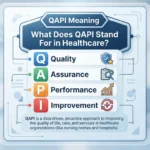
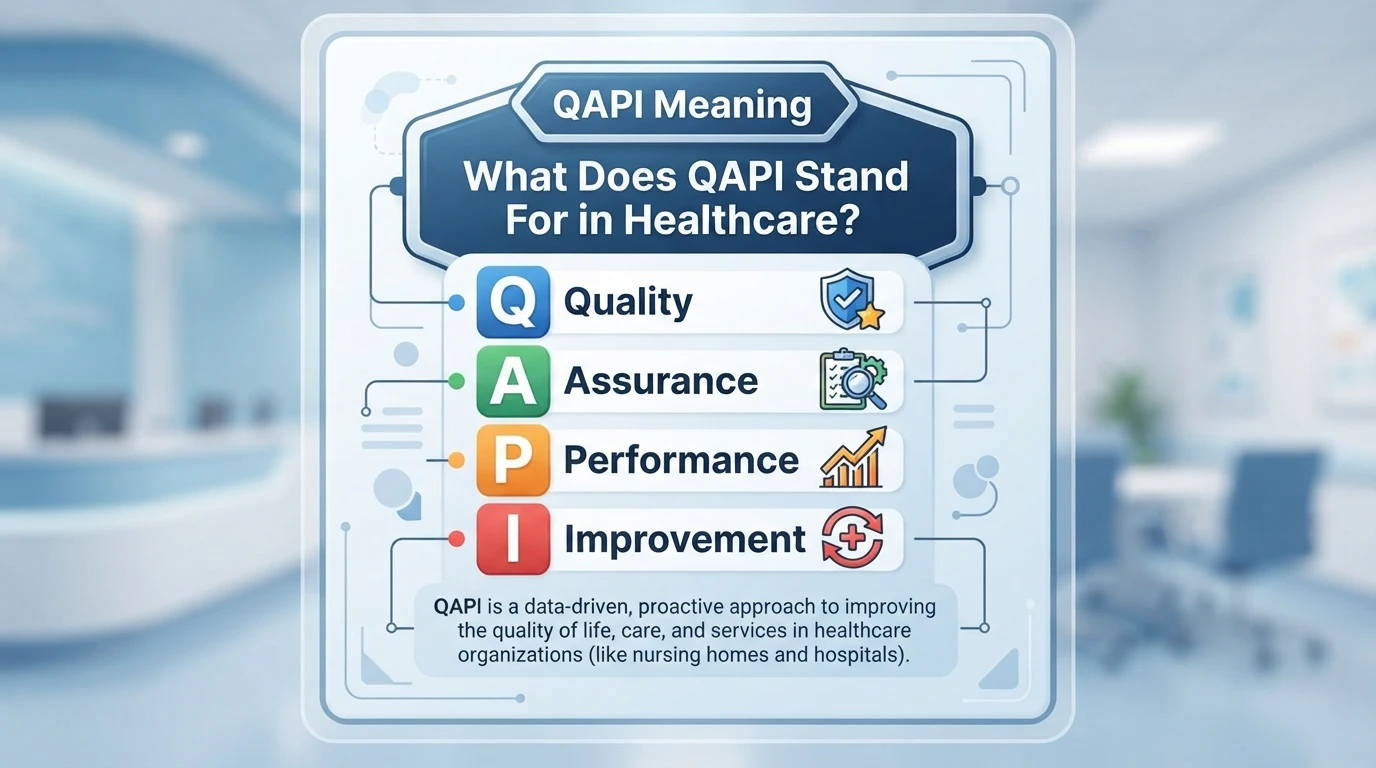
QAPI stands for Quality Assurance and Performance Improvement. It is a structured approach used in healthcare to improve the quality, safety, and effectiveness of patient care.
In simple terms, QAPI combines two important ideas: checking whether care meets established standards (quality assurance) and continuously looking for ways to make that care better (performance improvement).
The term is especially common in nursing homes, long-term care facilities, hospitals, and other healthcare settings. Understanding the QAPI meaning can help patients, caregivers, healthcare workers, and administrators understand how healthcare organizations identify problems, measure performance, and improve outcomes.
What Does QAPI Mean?
QAPI means Quality Assurance and Performance Improvement.
It brings together two related but different processes:
- Quality Assurance (QA): Makes sure healthcare services meet required standards.
- Performance Improvement (PI): Identifies opportunities to improve existing processes and outcomes.
Rather than simply finding mistakes and correcting them, QAPI encourages healthcare organizations to examine why problems happen and determine how systems can be improved to prevent them from happening again.
A Simple Example
Imagine a nursing home notices that several residents have experienced falls.
A traditional quality assurance approach might involve:
- Reviewing the incidents.
- Documenting what happened.
- Checking whether staff followed existing procedures.
- Taking corrective action when necessary.
A QAPI approach goes further.
The organization might ask:
- Why are residents falling?
- Are certain times of day associated with more falls?
- Are medications contributing to fall risk?
- Is lighting adequate?
- Are mobility aids being used correctly?
- Do staff need additional training?
- Can the environment be redesigned?
The goal is not simply to respond to individual incidents. It is to improve the overall system of care.
QAPI vs. Quality Assurance
Although quality assurance and QAPI are closely related, they are not identical.
| Quality Assurance | Performance Improvement |
| Focuses on meeting standards | Focuses on making processes better |
| Often identifies problems | Investigates causes and solutions |
| Can be compliance-oriented | Emphasizes continuous improvement |
| Checks whether requirements are met | Tests whether changes improve outcomes |
| Often looks at current performance | Looks for opportunities to improve future performance |
QAPI combines both approaches.
This means healthcare organizations can maintain compliance while also developing a culture of continuous improvement.
Why Is QAPI Important?
Healthcare organizations deal with complex systems, changing patient needs, staffing challenges, and safety risks. Even when employees follow established procedures, problems can still occur.
QAPI provides a framework for identifying those problems and improving the systems behind them.
Key goals of QAPI include:
- Improving patient safety
- Reducing preventable errors
- Improving quality of care
- Increasing resident and patient satisfaction
- Reducing avoidable hospitalizations
- Preventing infections
- Improving medication management
- Reducing falls and injuries
- Strengthening staff performance
- Improving organizational processes
The broader objective is to make healthcare safer, more effective, person-centered, and consistent.
How Does QAPI Work?
QAPI is generally a continuous process rather than a one-time project.
A healthcare organization may follow a process such as:
- Identify a problem
- Collect information
- Analyze the root cause
- Develop an improvement plan
- Implement the change
- Measure the results
- Adjust the approach
- Continue monitoring
This creates a cycle of ongoing improvement.
Step 1: Identify a Problem
The first step is determining what needs improvement.
For example, a facility might notice:
“Our rate of medication errors has increased during evening shifts.”
This gives the organization a measurable problem to investigate.
Step 2: Collect Data
The team gathers relevant information.
They may examine:
- Incident reports
- Patient records
- Staff schedules
- Medication administration records
- Survey results
- Patient complaints
- Infection rates
- Hospital readmission data
Data helps the team understand the size and nature of the problem.
Step 3: Find the Root Cause
Simply identifying a problem isn’t enough.
QAPI teams often investigate the root cause, meaning the underlying reason the problem occurs.
For example, medication errors might be associated with:
- Interruptions during medication rounds
- Inadequate staffing
- Poor communication
- Similar-looking medication packaging
- Unclear procedures
- Insufficient training
The goal is to address the underlying system rather than simply blaming an individual employee.
What Is a QAPI Program?
A QAPI program is an organized system through which a healthcare organization manages quality assurance and performance improvement activities.
A strong program generally involves:
- Leadership
- Staff members
- Patients or residents
- Families when appropriate
- Data collection
- Performance measurement
- Improvement projects
- Monitoring
- Documentation
Different organizations may structure their QAPI programs differently depending on their size, services, regulations, and patient population.
QAPI in Nursing Homes
QAPI is particularly associated with nursing homes and long-term care facilities.
In these settings, quality improvement may address areas such as:
Falls
Facilities can track:
- Number of falls
- Location of falls
- Time of day
- Injuries
- Risk factors
- Medication-related risks
The information can then be used to develop interventions.
Pressure Injuries
A QAPI project might examine why residents are developing pressure injuries.
The team could review:
- Repositioning practices
- Nutrition
- Mobility
- Skin assessments
- Equipment
- Staff training
Infections
Facilities may monitor infection patterns and identify opportunities to improve:
- Hand hygiene
- Cleaning procedures
- Isolation practices
- Antibiotic use
- Staff education
Hospital Readmissions
Another QAPI project might focus on reducing avoidable hospital transfers.
The team could examine whether better:
- Care planning
- Communication
- Monitoring
- Medication management
- Early intervention
could prevent unnecessary transfers.
QAPI and Person-Centered Care
One important part of modern healthcare quality improvement is person-centered care.
This means improvement efforts should not focus only on numbers and regulations. They should also consider the experiences, preferences, goals, and needs of patients or residents.
For example, reducing falls is important, but an organization should also consider whether safety interventions unnecessarily restrict a person’s independence.
A good QAPI program therefore asks:
“How can we improve safety and quality while respecting the individual’s preferences and dignity?”
Examples of QAPI Projects
QAPI projects can focus on many different healthcare issues.
| QAPI Project | Possible Goal |
| Fall prevention | Reduce preventable falls |
| Infection control | Reduce healthcare-associated infections |
| Medication safety | Reduce medication errors |
| Nutrition | Improve nutritional outcomes |
| Pressure injuries | Reduce preventable wounds |
| Hospital transfers | Reduce avoidable hospitalizations |
| Patient satisfaction | Improve patient experience |
| Staff training | Improve competency and consistency |
| Pain management | Improve pain assessment and treatment |
| Emergency preparedness | Improve response to emergencies |
The best project depends on the organization’s specific needs and available data.
QAPI and the Plan-Do-Study-Act Cycle
Many quality improvement programs use structured improvement methods such as the Plan-Do-Study-Act (PDSA) cycle.
Plan
Determine:
- What needs to change?
- What intervention will be tested?
- What outcome will be measured?
Do
Implement the change on a small or manageable scale.
Study
Review the data.
Ask:
- Did the intervention work?
- Did the outcome improve?
- Were there unexpected problems?
Act
Based on the results, the organization can:
- Adopt the change
- Modify it
- Test another approach
- Continue monitoring
This creates an ongoing improvement cycle.
QAPI Data: Why Measurement Matters
QAPI depends heavily on data.
Without measurement, an organization may believe that a change worked when it actually didn’t.
For example, suppose a facility introduces a new fall-prevention procedure.
Before the change:
20 falls per month
After implementation:
12 falls per month
This suggests improvement, but the team should examine additional information.
They may ask:
- Was the decrease consistent?
- Did the number of residents change?
- Were falls recorded consistently?
- Did the intervention create other problems?
- Was the reduction statistically or practically meaningful?
Good QAPI decisions are based on evidence rather than assumptions.
Common Misunderstandings About QAPI
Myth 1: QAPI Is Only About Finding Mistakes
Not exactly.
QAPI is broader than identifying errors. It focuses on improving systems, processes, and outcomes.
Myth 2: QAPI Is Only the Responsibility of Managers
A strong QAPI program involves people throughout the organization.
Depending on the project, participants may include:
- Administrators
- Nurses
- Physicians
- Therapists
- Nursing assistants
- Pharmacists
- Other healthcare workers
- Patients
- Residents
- Families
Myth 3: QAPI Is a One-Time Project
QAPI is designed around continuous improvement.
After one problem improves, another opportunity may become the focus.
Myth 4: QAPI and Quality Assurance Are the Same
They are related, but QAPI combines quality assurance and performance improvement.
Quality assurance helps ensure standards are met, while performance improvement focuses on making processes and outcomes better.
Benefits of QAPI
A well-designed QAPI program can provide several benefits.
Better Patient Safety
Identifying recurring risks can help organizations prevent avoidable harm.
Improved Quality of Care
Organizations can use data to determine which practices work best.
Stronger Teamwork
QAPI encourages employees from different departments to work together.
Better Patient Experience
Improving processes can make care more responsive and person-centered.
More Efficient Processes
Organizations may identify unnecessary steps, communication gaps, or workflow problems.
Stronger Organizational Culture
QAPI can encourage employees to view quality improvement as an ongoing responsibility rather than a task performed only during inspections.
A Real-World QAPI Example
Consider a long-term care facility where residents frequently miss scheduled appointments.
The QAPI team investigates and discovers that the problem is not simply transportation.
The team finds several contributing factors:
- Appointment information isn’t consistently communicated.
- Transportation requests are sometimes submitted late.
- Residents aren’t always reminded about appointments.
- Staff responsibilities aren’t clearly assigned.
The facility introduces a new process:
- Appointments are recorded in a shared schedule.
- Transportation is requested earlier.
- Residents receive reminders.
- One staff member verifies appointments each day.
After several months, the team compares missed appointments before and after the intervention.
If the number decreases significantly, the facility has evidence that the new process improved performance.
How QAPI Differs From a Traditional Audit
An audit often asks:
“Are we following the required standard?”
QAPI asks a broader question:
“Are we achieving the best possible outcome, and how can we improve?”
Both approaches are valuable.
An audit can identify compliance problems, while QAPI can help an organization understand why problems occur and how to improve the underlying process.
FAQs
What does QAPI stand for?
QAPI stands for Quality Assurance and Performance Improvement.
What is the main purpose of QAPI?
The main purpose is to continuously improve the quality, safety, effectiveness, and outcomes of healthcare services.
Is QAPI only used in nursing homes?
No. Although QAPI is strongly associated with long-term care, quality assurance and performance improvement concepts can be used across many healthcare settings.
What is an example of a QAPI project?
A nursing home might create a QAPI project to reduce falls, improve infection control, reduce medication errors, or decrease avoidable hospital transfers.
Who participates in QAPI?
QAPI can involve healthcare leaders, staff, patients, residents, families, and other stakeholders depending on the project.
What is the difference between QA and PI?
Quality assurance focuses on maintaining standards and identifying deficiencies. Performance improvement focuses on finding ways to improve processes and outcomes. QAPI combines both approaches.
Why is data important in QAPI?
Data allows healthcare organizations to measure performance, identify trends, determine whether interventions work, and make evidence-based decisions.
Conclusion:
The QAPI meaning is straightforward: Quality Assurance and Performance Improvement. But the concept goes beyond simply checking whether healthcare workers follow rules.
QAPI creates a structured approach to identifying problems, understanding their causes, testing solutions, measuring results, and continuously improving care.
The key difference is the focus on improvement. Instead of asking only whether something went wrong, a QAPI team asks why it happened and what can be changed to produce better results in the future.
Whether the goal is reducing falls, preventing infections, improving medication safety, increasing patient satisfaction, or reducing avoidable hospitalizations, QAPI helps healthcare organizations turn data and observations into meaningful improvements.
Ultimately, effective QAPI is about creating a healthcare environment where quality, safety, accountability, teamwork, and continuous improvement become part of everyday care.