The Mark Meaning can change depending on how and where the word is used. It may refer to a visible sign, a grade in school, a target, a person’s name, or even a symbol with a special purpose. Because the word has several meanings, understanding the context is essential. Learning the mark’s meaning helps you use the word correctly in everyday conversations, writing, and different situations. In this article, you’ll explore the various definitions of “mark,” its origin, common uses, examples, and related phrases to better understand this versatile English word.
Have you ever wondered what the word “mark” really means? You may have heard it in school when talking about exam scores, in business when referring to trademarks, in sports when marking an opponent, or even in everyday conversations like “leave your mark.” Because it has so many meanings, understanding the mark’s meaning depends on the context in which it is used.
The word mark is one of the most versatile words in the English language. It can refer to a visible sign, a score or grade, a target, a symbol, or even an impression someone leaves behind. Learning its different meanings can improve your vocabulary and help you understand English more naturally.
In this complete guide, we’ll explain the meaning of mark, explore its origins, discuss its various uses, provide real-world examples, clear up common misconceptions, and answer frequently asked questions.
Mark Meaning: Quick Definition
What Does “Mark” Mean?
Mark can be used as both a noun and a verb.
Simple Definition
A mark is a sign, symbol, score, impression, or indication that identifies, measures, or points out something.
As a verb, mark means:
To make a sign, identify, notice, or indicate something.
Mark Meaning in Different Contexts
The word “mark” has several meanings depending on where it is used.
| Context | Meaning |
| Education | A grade or score on a test |
| Writing | A symbol or sign |
| Everyday Objects | A stain, scratch, or visible spot |
| Business | A trademark or brand symbol |
| Sports | To closely guard an opponent |
| Navigation | A point of reference |
| Figurative | An impression or achievement |
Mark as a Noun
Most commonly, mark refers to something visible or measurable.
Examples
- There is a mark on the wall.
- She received full marks on her exam.
- The pencil left a mark on the paper.
- His speech made a lasting mark on the audience.
Mark as a Verb
As a verb, mark means to identify, label, or indicate something.
Examples
- Please mark the correct answer.
- The teacher marked our homework.
- They marked the trail with signs.
- Remember to mark the important pages.
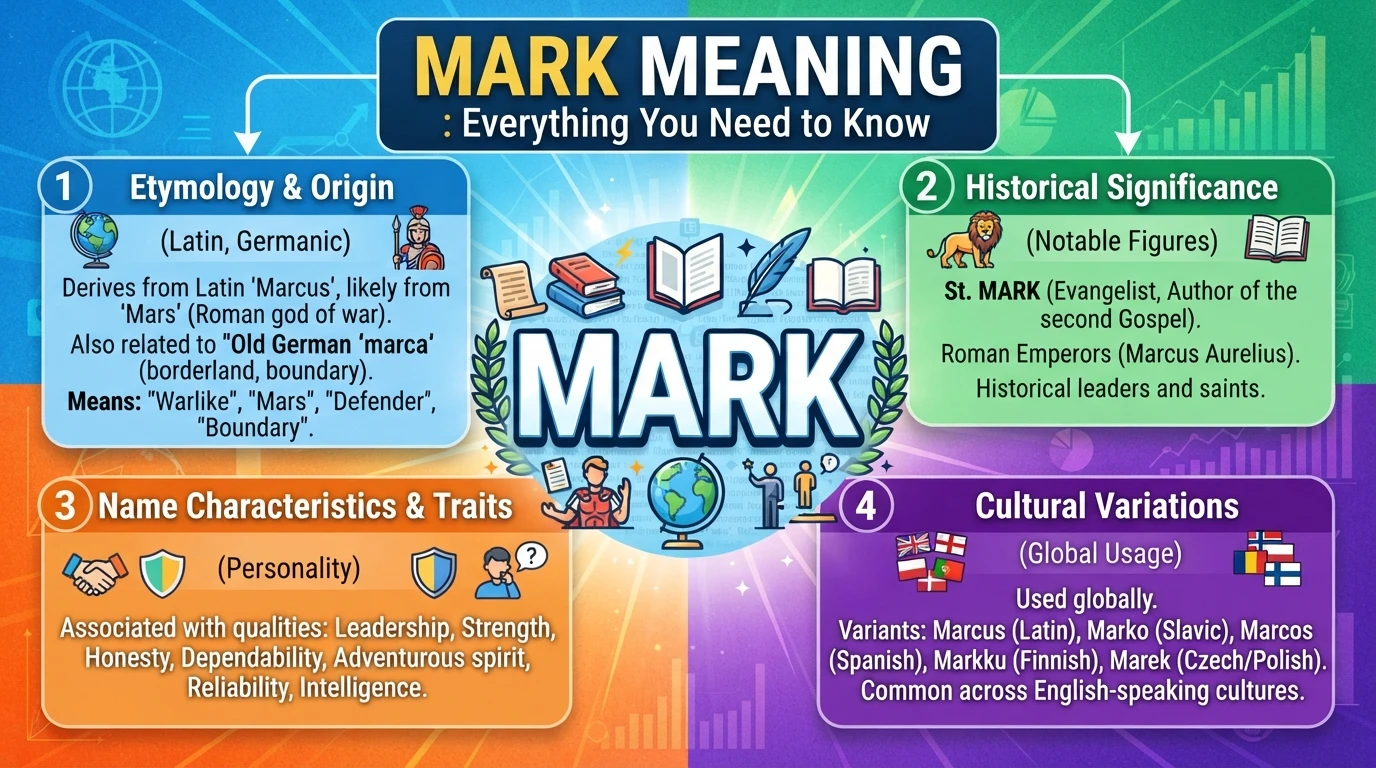
Origin of the Word “Mark”
The word mark comes from the Old English word “mearc,” meaning:
- Boundary
- Sign
- Limit
- Symbol
Over time, its meaning expanded to include grades, symbols, targets, and achievements.
Today, it remains one of the most commonly used English words.
Common Meanings of Mark
1. Mark as a Sign
A mark can be any visible indication.
Examples
- Ink mark
- Scratch mark
- Water mark
- Birthmark
Example sentence:
The coffee cup left a mark on the table.
2. Mark as a Grade
In education, a mark represents performance.
Example:
- She scored excellent marks in mathematics.
- He received a mark of 95%.
3. Mark as a Symbol
A mark may identify or represent something.
Examples include:
- Check mark ✔
- Question mark (?)
- Exclamation mark (!)
4. Mark as a Target
Sometimes “mark” refers to a target or goal.
Example:
The runner reached the finish mark.
5. Mark as an Achievement
The word can describe a significant accomplishment.
Example:
The scientist left her mark on medical research.
Different Types of Marks
There are many kinds of marks in everyday life.
Physical Marks
- Scratches
- Stains
- Scars
- Footprints
Written Marks
- Check marks
- Punctuation marks
- Mathematical symbols
Educational Marks
- Test scores
- Assignment grades
- Final exam results
Business Marks
- Logos
- Trademarks
- Brand identifiers
Common Idioms Using “Mark”
English contains many expressions using the word “mark.”
Leave Your Mark
Meaning:
To make a lasting impression.
Example:
She left her mark on the company.
Hit the Mark
Meaning:
To achieve the desired result.
Example:
His presentation really hit the mark.
Miss the Mark
Meaning:
To fail to achieve the intended goal.
Example:
The joke completely missed the mark.
On Your Mark
Meaning:
Prepare to begin.
Example:
On your mark, get set, go!
Mark My Words
Meaning:
Believe what I am saying because it will happen.
Example:
Mark my words—they’ll win the championship.
Mark Meaning in Education
One of the most common meanings relates to school.
Teachers assign marks based on:
- Homework
- Quizzes
- Projects
- Exams
- Participation
Example
| Score | Mark |
| 95% | Excellent |
| 85% | Very Good |
| 75% | Good |
| 60% | Pass |
Mark Meaning in Sports
In sports, marking often means guarding an opponent.
Example:
In soccer:
The defender marked the striker closely.
In Australian Rules Football, a “mark” also refers to catching the ball directly from a kick.
Mark Meaning in Business
Businesses use marks to identify products.
Examples include:
- Company logos
- Registered trademarks
- Brand names
These marks help customers recognize products.
Mark Meaning in Technology
In computing, “mark” may refer to:
- Highlighting text
- Selecting information
- Bookmarks
- Tracking changes
Example:
Mark the files for review.
Common Misconceptions About Mark
Myth 1: Mark Only Means a Grade
False.
It has many meanings beyond education.
Myth 2: Mark Is Always a Physical Spot
False.
It can also mean a symbol, score, or achievement.
Myth 3: Mark and Score Are Always Identical
False.
While related, “mark” is often used in British English, whereas “score” is more common in American English for test results.
Myth 4: Mark Is Only a Noun
False.
It functions as both a noun and a verb.
Myth 5: Every Mark Is Permanent
False.
Some marks disappear, while others leave lasting impressions.
Synonyms of Mark
Depending on context, synonyms include:
As a Sign
- Spot
- Symbol
- Trace
- Impression
- Indicator
Grade
- Score
- Grade
- Result
- Evaluation
Verb
- Identify
- Label
- Highlight
- Indicate
- Note
Real-Life Examples of Mark
Example 1
A student receives high marks after studying consistently.
Example 2
A traveler leaves footprints as marks in the sand.
Example 3
A company protects its trademark from unauthorized use.
Example 4
An athlete marks an opposing player during a soccer match.
Example 5
A famous inventor leaves a lasting mark on history through groundbreaking innovations.
Why Understanding “Mark” Is Important
Learning the different meanings of the word ” mark helps you:
- Improve English vocabulary
- Understand books and articles
- Communicate more accurately
- Interpret idioms correctly
- Perform better in academic and professional settings
Because it appears in many situations, it is one of the most useful English words to know.
FAQs
What is the meaning of mark?
A mark is a sign, symbol, score, impression, or indication used to identify, measure, or represent something.
Is mark a noun or a verb?
It can be both. As a noun, it means a sign or score. As a verb, it means to identify or indicate something.
What does mark mean in school?
In education, a mark is the grade or score a student receives for academic work.
What does “leave your mark” mean?
It means to make a lasting impact or impression.
What is the difference between mark and score?
Both refer to results, but mark is more common in British English, while score is more common in American English.
What is a trademark?
A trademark is a legally protected symbol, logo, or name used to identify a business or product.
Why does the word “mark” have so many meanings?
Its original meaning of a sign or boundary gradually expanded over centuries into many different contexts, including education, business, sports, and everyday language.
Final Thoughts
Understanding the mark’s meaning is essential because it is one of the most frequently used words in English. If referring to a visible sign, an exam grade, a business trademark, a sports strategy, or a lasting achievement, the word adapts to many different situations while maintaining its core idea of identifying, measuring, or leaving an impression.
By recognizing how meaning changes depending on context, you’ll improve your vocabulary, communicate more effectively, and better understand conversations, books, and professional language.