No-fault state meaning is an important legal concept that can be confusing, especially when dealing with car accidents and insurance claims. If you have ever wondered who pays for medical bills or vehicle damage after an accident, understanding this term can make the process easier to follow. A no-fault state generally requires drivers to turn to their own insurance for certain accident-related expenses, regardless of who caused the crash. In this article, you’ll learn the no-fault state meaning, how no-fault insurance works, its benefits and drawbacks, and how it can affect your rights after an accident.
Have you ever heard someone say they live in a “no-fault state” and wondered what that actually means? The term is commonly used in discussions about car insurance and divorce laws, which can make it confusing because its meaning depends on the context. Understanding the no-fault state meaning is important, especially if you’re involved in a car accident, considering a divorce, or simply want to know how state laws work.
In general, a no-fault state is one where the law reduces the need to prove who caused a particular issue before certain legal or insurance benefits apply. While the concept is most often associated with automobile insurance, it also appears in family law. This guide explains both meanings in simple language, along with examples, benefits, drawbacks, and common misconceptions.
No Fault State Meaning: Quick Definition
What Is a No Fault State?
A no fault state is:
A state where certain legal or insurance claims are handled without first determining who was responsible for the incident.
The exact rules depend on whether the topic is:
- Car insurance
- Divorce law
What Does No Fault State Mean in Car Insurance?
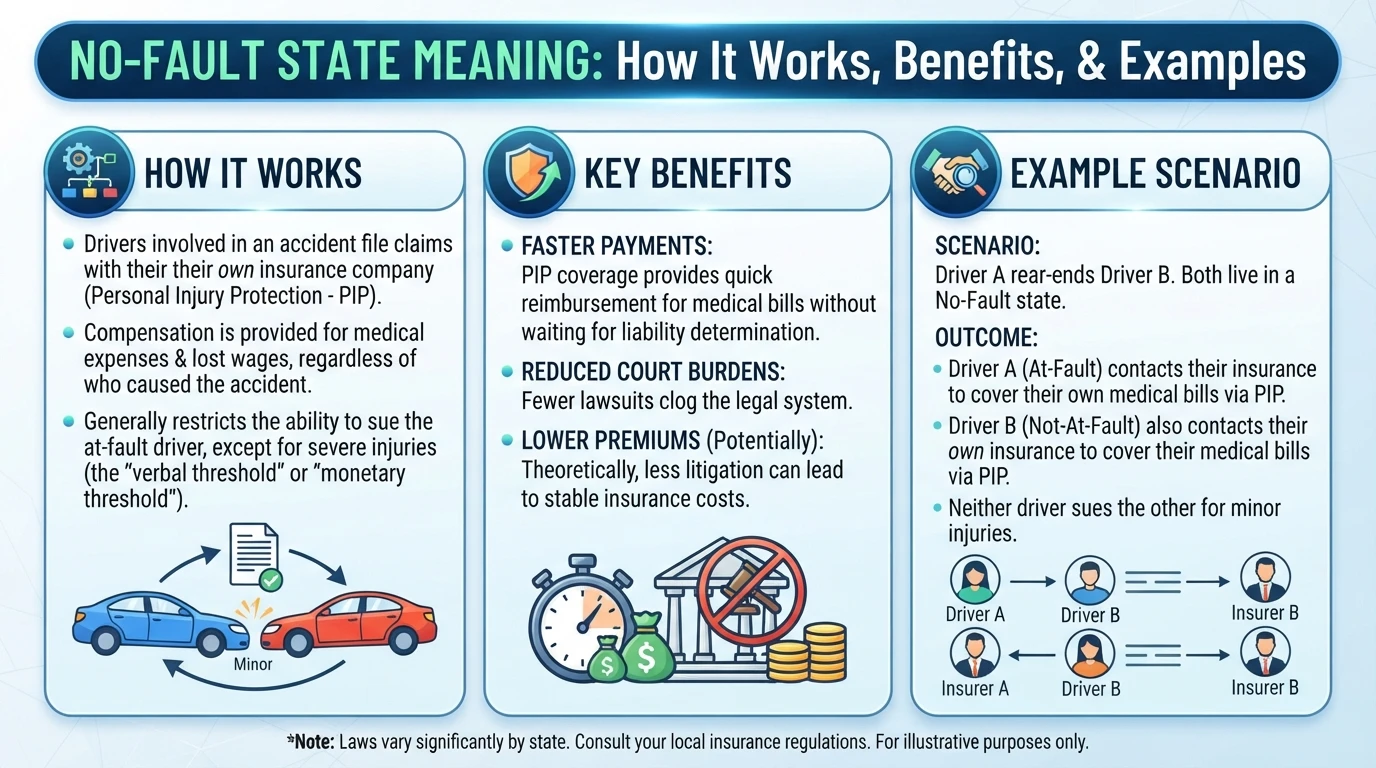
In auto insurance, a no-fault state requires drivers to use their own insurance coverage to pay for certain medical expenses after an accident, regardless of who caused it.
Simple Definition
If you’re injured in a car accident, your own insurance company pays your covered medical costs first, even if another driver caused the crash.
This system is designed to speed up claims and reduce lawsuits.
How No-Fault Car Insurance Works
Here’s a simple example.
Example
Sarah is driving when another car accidentally hits her vehicle.
In a no-fault state:
- Sarah files a claim with her own insurance company.
- Her medical expenses are paid through her Personal Injury Protection (PIP) coverage.
- She doesn’t usually have to prove who caused the accident to receive those benefits.
Depending on the severity of the accident, she may still be able to sue the at-fault driver under certain circumstances.
What Is Personal Injury Protection (PIP)?
Most no-fault insurance systems require Personal Injury Protection (PIP) coverage.
PIP may help pay for:
- Medical bills
- Hospital stays
- Rehabilitation
- Lost wages
- Essential household services
- Funeral expenses (in some cases)
Coverage varies by state and insurance policy.
Which States Have No-Fault Car Insurance?
Only certain U.S. states use no-fault auto insurance systems.
Some examples include:
- Florida
- Michigan
- New York
- New Jersey
- Hawaii
- Kentucky
- Massachusetts
- Minnesota
- North Dakota
- Utah
Some states offer optional no-fault insurance, while others follow a traditional fault-based system.
Because laws change over time, it’s always important to check the current rules in your state.
Benefits of No-Fault Car Insurance
1. Faster Claim Processing
Drivers receive benefits without waiting for fault investigations.
2. Quicker Medical Payments
Medical treatment can begin immediately through your own insurance.
3. Fewer Minor Lawsuits
Many small injury claims are resolved without going to court.
4. Reduced Legal Costs
Less litigation can lower legal expenses for many claims.
Limitations of No-Fault Insurance
Although helpful, the system has some disadvantages.
Higher Insurance Premiums
Some no-fault states have higher insurance costs.
Limited Right to Sue
Drivers often cannot sue another driver unless injuries meet specific legal thresholds.
Coverage Limits
PIP coverage may not pay every expense after a serious accident.
No Fault State Meaning in Divorce
The phrase also has a completely different meaning in family law.
Simple Definition
In a no-fault divorce state, a spouse does not need to prove wrongdoing—such as adultery, abuse, or abandonment—to file for divorce.
Instead, they can simply state that:
- The marriage has irretrievably broken down.
- There are irreconcilable differences.
- The relationship cannot be repaired.
Example of a No-Fault Divorce
Imagine a married couple who no longer get along.
Neither spouse committed misconduct.
Instead of proving fault, one spouse files for divorce based on:
“Irreconcilable differences.”
The court can grant the divorce without assigning blame.
Benefits of No-Fault Divorce
Less Conflict
Couples often avoid lengthy courtroom disputes.
Faster Proceedings
Many cases are resolved more quickly.
Lower Legal Costs
Fewer contested issues may reduce attorney fees.
Greater Privacy
Personal details often remain out of public court records.
No-Fault vs. Fault States
The difference depends on the legal issue.
Car Insurance Comparison
| No-Fault State | Fault State |
| Own insurance pays medical costs first | At-fault driver’s insurance usually pays |
| Uses PIP coverage | Liability insurance is primary |
| Limited lawsuits | More lawsuits permitted |
Divorce Comparison
| No-Fault Divorce | Fault Divorce |
| No wrongdoing required | Must prove legal fault |
| Simpler filing | Evidence often required |
| Less conflict | More adversarial process |
Common Misconceptions
Myth 1: No-Fault Means Nobody Is Responsible
False.
Responsibility may still be determined for vehicle damage, insurance claims, or serious legal matters.
Myth 2: You Can Never Sue in a No-Fault State
False.
Many states allow lawsuits if injuries are severe enough or damages exceed certain limits.
Myth 3: No-Fault Insurance Covers Everything
False.
Coverage depends on your policy limits and state law.
Myth 4: Every State Is a No-Fault State
False.
Only certain states follow no-fault insurance systems.
Myth 5: No-Fault Divorce Means Property Is Split Automatically
False.
Courts still decide issues such as:
- Property division
- Child custody
- Child support
- Spousal support
Real-Life Example
Suppose John lives in a no-fault insurance state.
Another driver accidentally hits his car.
John:
- Visits the hospital.
- Files a claim with his own insurer.
- Receives medical benefits through his PIP coverage.
If his injuries are extremely serious and meet the state’s legal threshold, he may also have the right to sue the at-fault driver for additional damages.
Why Understanding No-Fault Laws Matters
Knowing whether your state follows no-fault rules helps you:
- Understand insurance coverage
- Know your legal rights
- Prepare for accidents
- Handle divorce proceedings more confidently
- Avoid misunderstandings during legal claims
Related Legal Terms
Understanding these terms can also help.
Liability Insurance
Insurance that pays for damages you cause to others.
Personal Injury Protection (PIP)
Coverage that pays your own medical expenses after an accident.
At-Fault State
A state where the driver responsible for the accident generally pays for damages through liability insurance.
Irreconcilable Differences
A common legal reason used in no-fault divorce filings.
FAQs
What does a no-fault state mean?
A no-fault state is one where certain insurance or legal claims can proceed without first proving who was responsible.
Does no-fault mean no one caused the accident?
No. Fault may still be determined for property damage or serious legal claims.
What is PIP insurance?
Personal Injury Protection (PIP) helps pay your medical expenses after a car accident, regardless of fault.
Can you sue someone in a no-fault state?
Sometimes. Many states allow lawsuits if injuries meet specific legal requirements.
Is every state a no-fault insurance state?
No. Only certain states have no-fault auto insurance systems.
What is a no-fault divorce?
It allows spouses to divorce without proving that either person committed wrongdoing.
Why were no-fault laws created?
They were designed to simplify claims, reduce legal disputes, speed up compensation, and make certain legal processes more efficient.
Conclusion:
Understanding the meaning of “no-fault state” is important because the term appears in both car insurance and family law, and its meaning varies depending on the situation. In auto insurance, a no-fault state allows drivers to rely on their own insurance for certain medical expenses after an accident. In divorce law, it allows couples to end a marriage without proving that either spouse was at fault.
While no-fault systems can reduce conflict, speed up claims, and simplify legal procedures, they also have limitations and vary by state. Knowing how your state’s laws work can help you make informed decisions and better understand your rights.